
For posts on bullying, visit The Learn to be Buddies Series Blog.
All images and posts written by and copyright to Amanda Clements (nee Gray) 2009-2012 unless otherwise indicated.
Showing posts with label classroom management. Show all posts

Wednesday, November 25, 2009

Graphic Organisers: An example of a "least intrusive" adjustment

Graphic organisers are one of the best examples of an adjustment that can be made for students with disabilities whilst also benefiting all other students in their class.

What is a Graphic organiser?

Graphic organisers are things like tables, diagrams, flow charts, checklists. They can be used to visually represent the link between ideas, or the steps in a process. You can find many examples of graphic organisers at teach-nology.com or education.oasis.com

How would you use a Graphic organiser?

Lesson plans:

Graphic organisers can be used as lesson plans to help children be organised and stay on track....
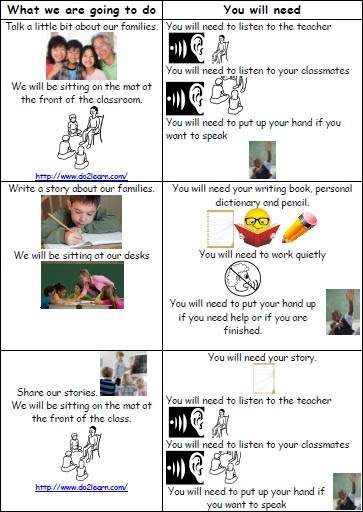


images from Microsoft clipart and www.do2learn.com

This would be important for a student who has attention and organisational difficulties such as ADHD, Autism, Down Syndrome, Bi-polar disorder and so on. However, something like this could be hung out the front of the room and used for the whole class as it could benefit all students.

Concept maps

These are very helpful to help children with recognising relevant vocabulary, as well as helping them to create links between ideas - which is an important process in learning and remembering things. They can be as simple or as complex as appropriate to the age of the child. They could also be made with pictures and words, or just pictures as well.


Writing and reading scaffolds

Graphic organisers are a great way to help children who struggle to organise their thoughts. It can help them write more coherent, longer stories or essays.

Giving a child who is struggling with literacy a story map before they read a story can also help them focus on the meaning of a story rather than just decoding the words on the page. Having a sense of how the story fits together. This will help them read more fluently as knowing what is going to happen gives children struggling with literacy a better chance of making correct "informed guesses" about any unfamiliar words on the page - a process we all use when reading, especially when we don't want to interrupt the flow of the story.

Story maps can be simple or complex. They can be used for children of all abilities, though you should never force children to use them as many children who are very creative, or gifted in story-writing, work best when they can just let the story flow from their pen. So the "least intrusive" use of story maps would be to use them in demonstrations and introduction to topics and stories, and then making them available for those who want to use them in their writing tasks.

For factual texts, KWL charts are a good way of activating interest and prior knowledge of a child. This can be very helpful for children with ADHD and Autism as it can help them become interested in the topic.

Simple or more complex main idea charts can help students organise their thoughts when they have to write assignments or essays on topics. These can be used in a similar way to story maps.


Instructions

We have probably all used checklists at one time or another. Checklists are another example of how graphic organisers can be used. Instructions can also be represented in a series of pictures - which is important for any child who is struggling to hear, remember or read instructions.


Rules for Using Graphic Organisers

Blaxendall (2003) discusses the benefits as well as the pitfalls of using graphic organisers. He suggests successful use of graphic organisers comes down to three things:
  1. Consistency: Regularly using the same set of organisers. This helps children get used to what each type of organiser is used for and what they symbolise.
  2. Coherence: Don't put any irrelevant information in an organiser - it is for important information only. Keep it simple.
  3. Creativity: Use them in as many situations as possible (classwork, homework, group work). Use pictures as much as possible, ensuring that they are age-appropriate and specifically relevant to the content of the organiser.

Reference:
Blaxendall, B. (2003). Consistent, Coherent, Creative: The 3 C's of Graphic Organisers. Teaching Exceptional Children, 35(3), p47.


.

Read more...

Wednesday, August 19, 2009

The dreaded power-struggle

“Mark, can you sit down and do your work please?”

“No.”

“Mark, sit down please.”

“I don’t want to.”

“Sit down.”

“Why?”

“Because….because you need to do your work.”

“I don’t want to.”…

Half an hour later.

“MARK THOMAS ANTHONY PETERSON! Put your BOTTOM on your SEAT or… or…”

“What are you goin’ #$%#$% do?” You quickly duck out of the way of a flying chair. “I said I don’t want to do it!!”

Angry, you confront him and say “Don’t you throw things at me!”

“I will @#$%@ do what I @%%# well like!!!”


…..

Have you ever been caught in an un-winnable argument like this? I have come close with a few children aged between 8-11 who were diagnosed with oppositional defiance disorder, ADHD or bi-polar disorder.

But I usually remembered just in time the important techniques that ensure the child, myself and other children around did not get hurt. Here is one of the techniques that helped me diffuse the situation.

Roger’s Chain of Action

Let’s re-tell this scenario following Roger’s “chain of action” (cited in Brady and Scully, 2005).

It’s homework time at home, or deskwork time at school.

You point to your schedule which is hung on the wall. “Okay, everyone/Mark. Its nearly time to work at your desks/do your homework. You will need your pencil case, your Maths book and your ruler (you write this on the board/on a sticky note and put it on his desk). I’ll set the timer for five minutes so you can get ready.”

Mark is clearly not moving. He looks in your direction to see what you will do.

Step one: Tactical ignoring

You decide to see what will happen if you ignore. The minutes tick away. Mark starts to do things like flicking spit-balls at his sister or throwing small projectiles such as his rubber at his peers.

Ignoring is obviously not working.

Step two: Simple direction, rule re-statement, or question and feedback.

As you are wandering around helping others, you stop close to Mark, ensuring you have his attention without getting “in his face”.

“What are you meant to be doing, Mark?”

“I dunno.”

“You can check the schedule if you don’t remember.”

“I’m not dumb.”

“I know that.” said with a genuine, warm smile. “So what are you meant to be doing?”

Mark reluctantly tells you.

“That’s great! You should have just enough time. There’s still one minute on the timer.”

He starts getting ready, albeit mumbling, “I hate maths!” But you have walked away and ignore this. You know he is capable of the work you have set, and he knows you are willing to support him where necessary, so discussion is not necessary and will only prolong the argument. Though you may want to quickly state these facts before you walk away.

Unfortunately, he discovers a tempting projectile in his equipment and starts to set up a catapult using his ruler in order to release some of his frustration. He’s not ready to stop fighting yet.

Its time to act quickly.

Step three: Repeat step two or take child aside and give them a clear choice.

You don’t waste time with reviewing what he is meant to be doing. Someone may lose an eye.

You put your hand on Mark’s catapult and ask him calmly, “Do you want to do this now, or during recess/your favourite TV show?”

“You can’t do that!” He is hanging for a showdown.

Calmly you say, “It’s your choice. You have about 30 seconds left on the clock.” Then you walk away (with the ruler and the projectile).

Conclusion 1: It works (and it usually did for me)

The success of this process relies on you having built a rapport with the child, respecting and caring for their needs. It also requires firmness, confidence and consistency in application. If you fail to follow-through with choices at any time the child will not take you seriously.

So don't "threaten", just state facts about what is going to happen.

Conclusion 2: He opts out and starts throwing larger projectiles.

So…

Step 4: Isolation, time-out, exit from the room.

Have a crisis management plan in place to respond to any escalating aggression.

At home:
You may have a punching ball or “outburst” space where he can have it out safely.

Or, if possible, remove Mark to his room where anything he breaks has consequences for him rather than the family – though it is likely that this could start another argument and you will be unable to get him out of the room.

Another option is to remove yourself and any other children to a different room.

But there must be consequences after the outburst has subsided. That is, you must follow through with the choice you gave him. So Mark will have to do his work later and miss out on his favourite show.

At school:
Have a “buddy teacher” who is in a room close-by to whom Mark goes to “cool down”. The buddy teacher will have a desk close to the door where he can sit unobtrusively. It would also be important to have some physical outlet, such as a stress-ball. Though just walking between rooms (always being within sight for duty of care reasons) may be enough for some children.

Alternately, you may have a telephone in your room and an agreement that you can call either the principal, the deputy principal or the head teacher for welfare, who will then come down and either remove Mark or stay with him whilst you move your other students to do their work in the lovely sunshine or the library as the case may be.

But, again, you must follow through with the choice you gave him. So Mark will either work on his Maths with you or another staff member (such as the principal or in the library) during recess.

This should be seen as a natural consequence for his actions, rather than a “punishment”, especially if (as his actions suggest) Mark is struggling with self-esteem or self-efficacy issues.

If you follow these steps you might find that you have avoided a power-struggle and saved yourself and others a lot of time and angst.


Reference:
Brady, L. & Scully, A. (2005). Engagement: Inclusive Classroom Management. Sydney: Pearson Education.


Interesting reading:
http://www.thespasticcentre.org.au/services/about_tsc/policies/s10-05.pdf
http://education.qld.gov.au/health/pdfs/healthsafety/mh-casestudy-behmgt.pdf
http://www.disability.wa.gov.au/dscwr/_assets/main/instructional/documents/doc/crisis_managment.doc
http://www.kidsguardian.nsw.gov.au/example-folder-5/Accreditation/Guidelines/guide_behav_mngt_v1.0.pdf
http://www.dadhc.nsw.gov.au/NR/rdonlyres/22C82E91-4AAA-4FB0-8C7C-C4C6F1DA3AD9/4576/behaviour_support_policy_january_2009.pdf
http://www.family-advocacy.com/help/Risk%20management%20flowchart%20for%20student%20behaviour.pdf
http://www.family-advocacy.com/help/DET%20risk%20management%20plan%20proforma,%20sample%20&%20guidance.pdf

Read more...

Tuesday, May 26, 2009

A teacher's perspective

Tuesday 26th May 2009 (Image and text copyright Amanda Gray 2009. www.learn2bebuddies.com.au )

Dear Amanda.

As I read the letter on your blog Dear Teacher (May,21) my heart went out to the parent who wrote this letter. In my 13 years of teaching I have heard many similar stories from parents with children with special needs. We as teachers do need to be reminded of the importance of stepping into a parent’s shoes and seeing their child as they see them. Much research and professional writing has been undertaken in the area of understanding children with special needs and challenging behaviours and many strategies for working with these children have been put forward. However, little is heard about supporting teachers who are teaching mainstream classes with several children with ADHD and other challenging behaviours. How does a teacher with no special education training survive and continue to enjoy teaching in this situation?

After 11 years of teaching I was given a class with four children with VERY challenging behaviours. During the course of the year two were diagnosed with having ADHD and it was evident that the other two had significant sensory processing difficulties. All of these children had difficulty interpreting social cues and constantly had social difficulties in the playground. I started the year enthusiastic, having always loved teaching, I saw this class as a challenge. However, as the year progressed the unrelentless situation in my classroom wore me down. I found that I spent my days managing behaviour and despite trying many strategies suggested to me nothing seemed to work with these children. I would end each day exhausted. To survive in this situation I felt I had to water everything I taught down to maintain classroom control. I felt that instead of functioning as a teacher I regularly had to function as a therapist as the individual needs of these children were so demanding that they required more attention than actual syllabus work. In the end I finished the year wanting to leave teaching.

Fortunately I have come out of this and have a great class this year. My love for teaching has returned and I look forward to going to work each day. My question is, how does a mainstream teacher with no special education training, survive this kind of situation and continue to provide a positive learning environment for the other children in the class? How do you address the needs of these children while still maintaining a high quality of pedagogy for all children in the class?


Thank you so much for sharing this. Just as it is important to hear the perspective of parents, it is also important to hear from teachers working with children who have special needs.

This is such a complex issue and one that has no easy answer. No matter how much we talk about innovative practice and extra support, there is always the issue of limited resources, time and the need to balance the needs of all children - and our own sanity.

I have no definitive answers as every situation is different, but in my time as a teacher I found the things that helped me and my collegues included:
- Much preparation and use of student-centred, hands-on learning such as learning centres (today technology is a great resource to use)
- A strict, structured routine (visually displayed and frequently referred to in the classroom)
- A set of rules and rewards negotiated with the students (again, displayed and frequently used)
- A close partnership with executive staff in implementing consistent, supportive and immediate consequences (eg. the child does their work in the principal's office or under supervision in the library when they are having a bad day - not as a punishment, but to help them "cool down").
- A collaborative focus on preventing behaviour issues before they escalated (which can be about asking someone else to come in and observe them in your classroom so you can together identify the purpose or triggers of the behaviour).
- Wherever possible, a close partnership with parents or other family members, respite staff and/or a buddy teacher who had built a rapport with the child/children (a volunteer in the classroom at the most difficult parts of the day, with whom the child has a good relationship, can make a big difference)
- A supportive partnership with another teacher with whom you can debrief

In one particular case a teacher with whom I worked had a great partnership with her student's parent. The student had a contract negotiated between the parent, student and the teacher. This contract set out the expectations of what the child was to achieve each day, a consequence and a reward system in response to their performance. The reward system included immediate points awarded according to tasks completed, and those points went towards a trip to MacDonalds with the child's parents (the child and the family chose the award).

They also had a "crisis management plan" in place. When the child was becoming disruptive, or was distressed, a process was put in place whereby a buddy teacher and/or the assistant principal would become involved.

While these don't "solve" the issues, they provide a network of informal support if the child is not eligible for extra funding support for resources such as a teacher's aide. It may also help to regain the balance between education and behaviour management.

And, believe it or not, special education teachers don't always have the answer either. Our profession is always about collaboration, asking for help and creatively using any resources we can get our hands on.

The bottom line is don't be afraid to ask for help. If you are a teacher in this situation, you might want to ask the principal if you are eligible for a support teacher (behaviour) to come into your classroom and observe what might be triggering difficult behaviour in the child. They may be able to suggest some things (such as those discussed in my previous posts) that can be integrated into the routine of your classroom to reduce the child's difficult behaviour without disrupting your teaching. A school counsellor may also be able to do this. Or you may have a special education teacher, or a support teacher (learning assistance) in your school who may also be able to help.

And to all you teachers out there who are supporting and including children with diverse needs in your classroom, you are doing a great job (and I don't mean that in a patronising way Lol).

You are making a difference.

Read more...

About This Blog

You are welcome to browse as you like... but please remember that everything here is copyrighted. To receive printable copies of articles that you can hand out to others, subscribe to the Learn to be Buddies newsletter at www.learn2bebuddies.com.au

Copyright Amanda Gray 2009-11


  © Blogger templates The Professional Template by Ourblogtemplates.com 2008

Back to TOP