Helping children stay on track
How do we help children who are constantly going off task? How do we help children who don't think before they act?
Reducing distractions
One of the most important ways to help children with inhibitory control difficulties stay on task is to reduce the number of things going on in the child's environment.
- When learning: In the classroom there are many possible distractors. These can include things hung on walls, peers talking, movement around the room or outside a window. One key strategy is to have a seating arrangement that means the child is sitting away from windows, facing the front with no peers between them and the teacher and no distracting wall hangings within their direct line of site. Keep ambient noise low, paying attention to the noise coming from fans, heaters and other students.
Having clear, written rules that have been negotiated with your students will also be essential to maintain a distraction-free environment and help children with inhibitory control issues stay in their seat and on-task. You will need to have a display of these rules and frequently refer to them.
- When doing homework: It is important that a child with executive functioning difficulties not be expected to complete a task requiring concentration in a room that has many distractors. Many of these children benefit from a quiet, clear space away from TVs, toys, computers and other possible distractors.
Expect concentration on only one thing at a time
Use Pointers
Reading can be a very difficult task for children who have trouble with their "inhibitory control" because it can effect their concentration. They can lose track of where they are in the text, skipping words or even whole lines. They can be distracted by noises, and find it hard to pick up where they left off.
An effective tool is a pointer. This can be anything from a child's finger, to a laser pointer on the board, or a ruler under the line they are reading. Another tool is a little window cut out of a piece of card large enough for the child to only see one or two lines of the text at a time.
Using colour-coding can also be useful. You can highlight key words by writing or highlighting them in different colours. You can write/highlight the beginning of each paragraph, sentence or line in a different colour to help children keep track.
Break it down
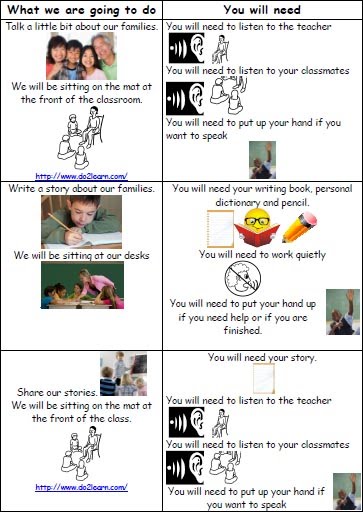
Big chunks of information, or lots of steps in a task, will be hard for a child to remember if they are struggling to filter out distractions. To address this we should break tasks down so they can focus on one step at a time. The best way to do this is through checklists or graphic organisers (British Columbian Ministry of Education, 2010).
You can use visual checklists on Velcro strips where a child can remove a picture and put it in a "finished" box as each step is completed. Some places where you can get free visuals include www.visualaidsforlearning.com and www.do2learn.com
You can use a written checklists for children with good literacy skills, ensuring they can check each step once it has been completed.
It could also be beneficial to have relevant rewards for each step that has been completed. For example, a child might get 1 point each time they finish a step, and once they have gathered 10 points they are able to dip into a lucky dip of small items relevant to their interest. Other children will be motivated by merit certificates, and others by time doing a favourite activity.
Here are some charts you might be able to use:
Reducing distractions
One of the most important ways to help children with inhibitory control difficulties stay on task is to reduce the number of things going on in the child's environment.
- When learning: In the classroom there are many possible distractors. These can include things hung on walls, peers talking, movement around the room or outside a window. One key strategy is to have a seating arrangement that means the child is sitting away from windows, facing the front with no peers between them and the teacher and no distracting wall hangings within their direct line of site. Keep ambient noise low, paying attention to the noise coming from fans, heaters and other students.
Having clear, written rules that have been negotiated with your students will also be essential to maintain a distraction-free environment and help children with inhibitory control issues stay in their seat and on-task. You will need to have a display of these rules and frequently refer to them.
- When doing homework: It is important that a child with executive functioning difficulties not be expected to complete a task requiring concentration in a room that has many distractors. Many of these children benefit from a quiet, clear space away from TVs, toys, computers and other possible distractors.
Expect concentration on only one thing at a time
Use Pointers
Reading can be a very difficult task for children who have trouble with their "inhibitory control" because it can effect their concentration. They can lose track of where they are in the text, skipping words or even whole lines. They can be distracted by noises, and find it hard to pick up where they left off.
An effective tool is a pointer. This can be anything from a child's finger, to a laser pointer on the board, or a ruler under the line they are reading. Another tool is a little window cut out of a piece of card large enough for the child to only see one or two lines of the text at a time.
Using colour-coding can also be useful. You can highlight key words by writing or highlighting them in different colours. You can write/highlight the beginning of each paragraph, sentence or line in a different colour to help children keep track.
Break it down
Big chunks of information, or lots of steps in a task, will be hard for a child to remember if they are struggling to filter out distractions. To address this we should break tasks down so they can focus on one step at a time. The best way to do this is through checklists or graphic organisers (British Columbian Ministry of Education, 2010).
You can use visual checklists on Velcro strips where a child can remove a picture and put it in a "finished" box as each step is completed. Some places where you can get free visuals include www.visualaidsforlearning.com and www.do2learn.com
You can use a written checklists for children with good literacy skills, ensuring they can check each step once it has been completed.
It could also be beneficial to have relevant rewards for each step that has been completed. For example, a child might get 1 point each time they finish a step, and once they have gathered 10 points they are able to dip into a lucky dip of small items relevant to their interest. Other children will be motivated by merit certificates, and others by time doing a favourite activity.
Here are some charts you might be able to use:
- Desk Chart
- Step-by-step Chart
- Flow Chart
- Homework checklist (for older children)
- Chain of events
Stop, think, do....
To help children who are struggling to think before they act the steps involved in the Stop, Think, Do program can be used. I have discussed this previously here and here.
In conclusion...
Here is a great checklist from the British Columbian Ministry of Education that can help teachers working with children who have ADHD: www.bced.gov.bc.ca/specialed/adhd/app4.htm The strategies in this document could be helpful for any child who has executive functioning difficulties.
References
British Columbian Ministry of Education (2010) Teaching Students with Attention-Deficit/Hyperactivity Disorder: Planning for Success at School. Retrieved 31st July, 2010 from www.bced.gov.bc.ca/specialed/adhd/plan.htm