For posts on bullying, visit The Learn to be Buddies Series Blog.
All images and posts written by and copyright to Amanda Clements (nee Gray) 2009-2012 unless otherwise indicated.
Showing posts with label collaboration. Show all posts

Wednesday, February 17, 2010

Home-school communication that works

By Amanda Gray ..... Copyright Amanda Gray 2010

In talking to parents about their relationships with schools one of the key ingredients that make it a success... or not... is communication.


For parents who enjoy a good relationship with their school, positive, two-way communication is something they often talk about. For example, parents who feel their school is supportive often mention things like:
  • Their child's teacher is always available for a chat.
  • If they tell the teacher about an issue, the teacher will react in a supportive and prompt way.
  • The teacher acts on what has been discussed with the parent.
  • Even if they have different opinions, they can work out a solution based on mutual respect and an understanding that both the school and family have the child's best interest at heart.
Parents whose relationship with their child's school is not what they would like it to be often mention at least one of the following things:
  • It is hard to find anyone to talk to...
  • The principal/teacher is not really listening because they don't do anything about issues discussed, don't tell the family what is being done, or don't take the family's wishes into consideration.
  • They feel overwhelmed by "professional-speak", and come out of meetings confused or stupid.
This gives us some good hints about home-school communication that actually works.


Informal contact

Roffey (2002) reports on research exploring the relationship between schools and families who have children with behavioural difficulties. One of the things they found was the value that families placed on informal interactions. For example, they report one parent saying,
"If he wanted to talk to you, he'd say: 'Can I have a word?'. you know, privately. He was really good at that, I liked him." (p33)
So being able to catch a teacher, or visa versa, at times during the day is important. But the ability to do this changes as children get older.

In the pre-school years, this informal contact is regular and relatively easy as families pick up and drop off their children. In the early primary school years, this may also be true. But, as children learn to catch the bus and attend school independently, this informal, face to face contact is more difficult.

Using phone contact is perhaps the next best thing. Or using the phone to set up an informal face-to-face chat, especially in the middle and high school years. However, for working parents there is the added difficulty of making appointments during the school day. Taking time off work, or dashing down during the lunch hour, is not always an option.

One of the factors that make informal, face-to-face communication valuable is time. If it is planned appropriately, then it can be done in a calm way.

Further, it is important that difficult issues be addressed privately (Roffey, 2002). For example, it is important not to talk about a child in front of them or their peers. This can have an impact on a child's self-esteem, and can lead to self-fulfilling prophecies or teasing. The only exception would be if you wanted to involve the child in the discussion, but care would need to be taken that they didn't feel disempowered by having two adults "against" them.


Regular communication

Communicating regularly, and not just when there is a problem to solve, is important (Coleman, 1998). If communication between home and school starts on a positive note, and continues to be dotted with positives, then this can help build trust and a feeling of partnership rather than an "us versus them" feeling. It helps parents see that teachers know their child's strengths, not just their difficulties. And positive feedback from parents helps teachers further understand the child's strengths and build a positive, mutual understanding with families.

Regular communication becomes even more important for children who have a disability that affects their ability to telling their parents about their school day. This can mean that parents feel quite isolated from the education environment if there is no regular, day-to-day feedback from teachers or if the parents are unable to visit or volunteer at the school.

In these cases, one of the most effective tools to use is a communication book. Follow this link to read about some great ideas for home-school communication books. If you don't want to read the whole article, skip down to page 5 for some great examples.

Regular feedback is also important to ensure that families and teachers become aware of issues before they escalate (Coleman, 1998). For example, parents may see a change in their child's behaviour at home that could indicate that difficulties such as bullying is happening at school. Passing this on to teachers could help the teacher be more vigilant, observing the child closely for what might be happening.

Or a teacher may be finding a child is beginning to show some behavioural difficulties. By letting a parent know before it becomes a big issue, they may find out that there are some changes happening at home (such as a new baby, moving house, a change in routine) that could be contributing to the difficulties at school.

But ultimately, communicating regularly is an essential tool in preventing social and behavioural issues from escalating. Further, it is important for positive and collaborative problem-solving.

The other side of this is that regular feedback will ensure the family knows what is being done to address an issue at school. Being informed means that they don't feel the problem is being ignored, and that they can help with reinforcing the solution through discussion and strategies at home. This continuity is very important for lasting behaviour change or academic progress.


Openness, honesty and respect

In the previous post, I discussed the importance of open and honest communication to the development of trust.

It is also important that if there is a problem, the discussion be focused on the issue not on the child or the teacher/school (Boult, 2006).

For example, if a teacher is concerned about a child who is hitting, kicking or pushing on the playground, the conversation may go like this (after the usual greetings and a comment about what Sam has achieved lately)....
"Well, I did want to talk to you about some concerns I have about what is happening on the playground for Sam. I was just wondering if he had mentioned anything to you, or if you have noticed anything different at home?..."
This opens up the conversation to be about what is happening, and what may be contributing to the issue. This is more likely to bring about a positive partnership in problem-solving than a phone call home to request a suspension meeting, or to tell the parent about the negative behaviours and the disciplinary measures to be implemented. This is because the parent is seeing the teacher/school's concern for the child and a desire to change what is happening.

On the other side of the story, if a parent has a concern about something that is happening in the classroom, a good way to open the conversation may be...
"Sam is really loving the games she gets to play at music time. I was just wondering if you were aware of any problems she might be having with the other children saying things about her in that class?...."
This can then open up the conversation about what the teacher may/may not have noticed, what the parent's concerns are, the basis for these concerns, and what might be done about it.

Speaking with respect, empathy and a willingness to take on board both sides of the story is important to the problem-solving process.


The balance of power
"I sometimes feel a bit sidelined in meetings, I just feel they use all their terms that I don's understand and they know the system more than I do anyway - that's probably why I feel an outsider." (Roffey, 2002, p37)
It is important to consider the context of communication in meetings. A parent can be intimidated and disempowered in their role of advocate for their child if they attend a meeting with a number of school representatives using educational jargon. They can feel disempowered if they don't have all the information they need about policies and procedures before they come to a meeting.

It is important that any meeting occur on the basis of:
  • common goals
  • a willingness to negotiate and value each other's input equally
  • shared information
  • shared responsibility, this way avoiding blaming each other
  • apartnership, rather than a school being the decision-maker and parents the "supporters". (Rose and Howley, 2007)
If parents are feeling an imbalance of power, it is within their rights to bring someone with them to meetings. This can be an extended family member, a friend or a professional. One parent I talked to brought along her private speech therapist to learning support team meetings to help with the funding application process. Other families have used professional advocacy services such as the Disability Advocacy Service, who can attend meetings with parents and provide support through their knowledge of the school and legal systems. Early intervention services such as the Strengthening Families service will also support parents in meetings as they begin to negotiate the transition to school.


....

"Parents want to know what is going on for their child in school. They prefer informal contact that is positive, regular, private, planned, non-intrusive, two-way and early enough to make a difference." (Roffey, 2002 p 33)

....

References

Boult, B. (2006). 176 Ways to Involve Parents: Practical Strategies for Partnering with Families. Corwin Press: California.

Coleman, P. (1998). Parent, Student and Teacher Collaboration: The Power of Three. Corwin Press: California.

Roffey, S. (2002). School Behaviour and Families: Frameworks for Working Together. David Fulton Publishers: London.


Rose, R., and Howley, M. (2007). The Practical Guide to Special Educational Needs in Inclusive Primary Classrooms. Paul Chapman Publishing: London.

Read more...

Thursday, February 11, 2010

Home school collaboration: the importance of trust and how to build it

Research has shown a clear link between family involvement at school and a child's educational achievement. This is especially significant for children who have disabilities (Sheehey, Ornelles & Noonan, 2009). This highlights the importance of schools and families working together.

However, making home-school partnerships work is something that doesn't always come easy. It is important that we look at the things that can make it work.

Trust

One of the things that you often come across when reading or talking about working with schools is the concept of trust. As Boult (2006) states:

"The key to success [in creating an accepting climate] is trust and respect of one another's roles in the education of children." (p37)
Looking at information about trust in home-school relationships, Adams and Christenson (2000) defined trust as
"confidence that another person will act in a way to benefit or sustain the relationship, or the implicit of explict goals of the relationship, to achieve postive outcomes for students." (p480)
In short, to trust another person we need to have an understanding of a common goal (positive educational achievement for the child), a genuine commitment to that goal, and an ability to openly and honestly communicate without fear of negative consequences.


Building Trust

Lewis (2004) lists the ingredients of trust as being "respect, competence, personal regard and integrity" (p483)


Respect

As the quote from Boult suggests, respecting each other's roles is important. Conflict can often arise when families feel they are not being heard, or when teachers feel that parents do not understand the nature of their job.

One of the reasons why families may feel disrespected is because teachers or schools may not be recognising the value of their "expertise".

A family's expertise lies in their anecdotal and experiential knowledge of their child (Hughes & MacNaughton, 2002). While this knowledge is different to that of a teacher, it is not less valuable. We can only find out what makes a child who they are by listening to parents, especially if the child is not able to communicate these things themselves. And this is what makes parents such powerful advocates.

But while there is great value in seeing the individual through parents eyes, it is also important that there is clear communication and respect for the nature of the classroom and the education system.

Schools and other professionals must work within a system. This system provides philosophical guidelines, resourcing policies, physical facilities and so on. To create positive working relationships, be open and honest communication about these guidelines and policies from schools is important (Olsen, 2003; West-Burnham, Farrar & Otero, 2007). And schools need respect and support from families to help them make the most of their resources and facilities within those guidelines.

Without this mutual respect and recognition of each other's strengths and limitations, it can be easy to fall into the trap of the blame game (Roffey, 2002). So instead of working together on a solution, a school may "blame" parents for a child's inappropriate behaviour and suggest the family finds solutions. Alternately, the family may feel the child's behaviour is only inappropriate at school and expect the school to deal with it.

With mutual respect, both sides are more likely to be open about the nature of the behaviour, how often it occurs and possible triggers. And this is likely to be a catalyst for positive planning and change (Minke & Anderson, 2005).

In this way we move from seeing the interaction as "parent involvement" and start seeing it as a working partnership.


Competence

Having a knowledge of all parties roles and limitations means that we are less likely to have unrealistic expectations. As discussed in the context of bullying, schools have to work within the guidelines of the system. If schools help parents understand these more fully, then families are more likely to see schools and teachers a competent.

However, it is important that both families and schools/teachers are genuinely committed to the process of collaboration. This process involves not only meeting, discussing and planning - it is also about implementing what has been discussed in a timely manner.

Families will find it difficult to trust schools or teachers who they perceive to be slow in acting on what has been discussed (Roffey, 2002). There may be a number of reasons why action may seem slow in coming - including the possibility that approval or resourcing processes take time in the school system, or that the school/teacher has failed to provide the parent with updates about progress. Therefore, it is important that a) the family understand the processes involved in achieving change and b) that the school/teacher communicate regularly with the family about the process.


Personal Regard

Informal, frequent contact between teachers and families is just as, if not more, important than formal meetings and notes home. This is because informal contact provides an environment where relationships can develop.

The importance of developing relationships is to ensure there is an understanding of each others' beliefs and culture (West-Burnham, et al 2007). It helps to build common ground on which future problem-solving can be based.

It is also important to recognise that much of the formal communication involves dealing with social, behavioural or academic difficulties. However, to establish trust and a good working relationship, a focus on the positives is important. Talking about the small achievements of students during the day can play a significant part in building a positive partnership between families and teachers/schools (Boult, 2006; Ouellette, Briscoe and Tyson, 2004).

The other element of this is the importance of talking about things face to face (Boult, 2006). Sending a note home, emailing, or telephoning all take away the element of personal contact. It limits the ability of both parties to "read" each others' emotions. It also means that there can be some delay or misunderstandings in an exchange of views. Person to person contact can mitigate the effects of communicating unwanted news, such as concern over a student's development or behaviour, through body-language that communicates respect, support and empathy.

So having conversations rather than formal discussions is a key to developing trust (Croft, 2010).


Integrity

As mentioned previously, honesty and transparency about policies, procedures, beliefs and limitations are an important ingredient for trust.

Other measures of integrity may include:
  • Respecting the level confidentiality expected by the family/school
  • Being genuine
  • Avoiding assumptions
  • Following through with commitments
(Boult, 2006; Roffey, 2002; West-Burnham et al., 2007)

...

"A straightforward model of parental involvement requires that parents and teachers come together in a spirit of mutual trust and openness." (Roffey, 2002 p 131)

...


References:

Adams, K.S. and Christenson, S.L. (2000). Trust and the Family-School relationship: Examination of Parent-Teacher Differences in Elementary and Secondary Grades. Journal of School Psychology, 58(5), pp477-497.

Boult, B. (2006). 176 Ways to Involve Parents: Practical Strategies for Partnering with Families. Corwin Press: California.

Croft, C. (2010). Talking to Families of Infants and Toddlers about Developmental Delays. Young Children, 4(7), p44.

Hughes, P. and MacNaughton, G. (2002). Preparing Early Childhood Professionals to Work with Parents: The Challenes of diversity and Dissensus. Australian Journal of Early Childhood, 27(2). pp14-21.

Lewis, A.C. (2004). Schools that Engage Children. Phi Delta Kappan, 85(7), p483.

Minke, K.M., and Anderson, K.J. (2005). Family-School Collaboration and Positive Behavior Support. Journal of Positive Behavior Interventions, 7(3), pg. 181

Olson, L.M. (2oo3). Pathways to Collaboration. Reclaiming Children and Youth, 11(4), pg. 236

Ouellette, P.M., Briscoe, R., and Tyson, C. (2004). Parent-School and Community Partnerships in Children’s Mental Health: Networking Challenges, Dilemmas, and Solutions. Journal of Child and Family Studies, 13(3), pp. 295–308.

Roffey, S. (2002). School Behaviour and Families: Frameworks for Working Together. David Fulton Publishers: London.

Sheehey, P., Ornelles, C. and Noonan, M.J. (2009). Biculturalization: Developing Culturally Responsive Approaches to Family Participation. Intervention in School and Clinic, 45(2), p132-139.

West-Burnham, J., Farrar, M. and Otero, G. (2007). School and Communities: Working together to transform children's lives. Network Continuum: London.


Read more...

Monday, February 8, 2010

The first contact

The first contact in any relationship sets the tone for the future.

Here are some examples of the types of first contact a parent may have with a school or teacher. The question is... how will each of these influence the future parent-teacher/school relationship?

The Phone Call

"Hello?"

"Is that Mrs. Tompkins?"

"Speaking."

"This is Silent Street Public School. There has been an incident with Sam."

Ker-thump, ker-thump, ker-thump (Mrs. Tompkins' heart beat)

"We would like you to come in and meet with Mrs. Ellison, the principal. How soon can you make it?"

"Uhm... I am at work." Mrs. Tompkins is still feeling a little stunned.

"Mrs. Tompkins, this is very important."

"What kind of incident?" Mrs. Tompkins is recovering.

"It is probably best that the Mrs. Ellison talks to you about that. Can you make it in half an hour?"

"Uhm. I suppose I could - "

"Thank you. Come to the front office. Bye, now."

Click.


The parent-teacher night

Don and Rose walk into the room where they are met by Lee's teacher, Mark. Mark greets them and they sit down together.

After some small talk about the weather, Mark begins to ask questions:

"Are there any concerns about Lee's reports? Do you have any questions about how he may be doing?"

"No, we are pretty happy with how he is going. He loves coming to school, and he is doing really well at Maths. Though he doesn't seem to be making friends very easily."

"Yes, there have been some social difficulties. He reacts aggressively and can be rather loud within the classroom. And he also has problems with literacy activities, fine and gross motor activities."

"Oh."

"I have been doing some reading, and I am wondering if you have considered getting Lee assessed for Aspergers or ADHD."

"Oh." Stunned silence.

"It's just that I think there is something wrong... no, I mean different... about Lee that we need to have addressed."

From there the meeting doesn't go well. Lee's father becomes silently hostile, and Lee's mother is visibly upset.

The meeting ends abruptly, with Lee's father saying, "I think we would know if there was anything wrong with Lee. He has always been unique. But that's just Lee!"


A note

Dear Parents,
We are looking for volunteers to help in various capacities around the school. Please contact us if you can help us with any of the following:

  • Morning reading groups
  • Morning maths groups
  • Canteen duties
  • Excursion supervision
Your time would be greatly appreciated.


A classroom visit

The first time she met the person she thought was going to be Ashley's teacher was at the orientation day. It wasn't so much a meeting, as an introduction, because there were a number of other parents and they were really only there to observe and integrate their children into a classroom for some "practice".

Marianne thought was a great idea, but it was over so quickly. And while she had been able to see the teacher at work, she wished she had had more time to talk to the teacher. She wanted to know more about the type of person who was going to include Ashley in the classroom.

Only, when she dropped Ashley off for the first day of school the teacher was not the one she had met previously. After a brief, "Hello" it was time to leave Ashley in the teacher's care.


Enrolment

"We can have your child in our school, but we do have some concerns about how well we can support them. Have you explored all the other options? There is the special school in ..."

"We want Nat to be in an inclusive classroom. We decided that was important. And the special school is an hour's drive away, and all Nat's siblings are here at your school."

"Welllll, we'll see what we can do. We will need to talk to our Kindergarten teacher...."


A Learning Support Team meeting

"Hello?"

"Mr. Bellick?"

"Speaking."

"We are just ringing to let you know that there will be a planning meeting for your child at 4pm on Wednesday. Feel free to come along if you are able."

"What is a planning meeting?"

"Well, for children who have special needs we have meetings to identify what support will be needed, where we can get it and how this will be used in the classroom. Parents have a right to come to the meeting."

"Oh. OK. I will be there."

Mr. Bellick turns up on Wednesday, walking in to sit across the room from the principal, the teacher, the head teacher for welfare and the integration support teacher from the local Department of Education office.


An unexpected encounter

"Hi, Ms. Johnson. I am Miss Carter. Hello, Jay! Why don't you go and sit with Jo - just here. So how are you feeling, Ms. Johnson?"

"Oh, I'm a little nervous."

"I am sure Jay will be fine. Is there anything you are particularly worried about?"

"It's just that, well, Jay doesn't really know anyone here. And he is very shy and gets anxious if he doesn't know what is coming next."

"That's good to know. I always try to warn my class of what is coming next, and I have a picture timetable of what we are going to do in class. Is there anything he particularly likes to do? Or anything that will help if he is anxious or upset?"

"He usually needs a nice quiet space. He loves puzzles. We often get him to go do puzzles if we see he is getting anxious."

"Great. Well, we will be sure and call you if there are any problems. But I shouldn't think we will need to. And I have this little communication book where I will write a little comment about his day, and you can put any comments or questions, if I don't get to catch up with you after school."

"Thank you."

Read more...

Thursday, February 4, 2010

Ask Amanda: Why aren't they DOING something?

by Amanda Gray

It is a question that has been asked me by parents a number of times. It comes in different forms. But basically each question is getting at the same idea: "Why isn't the school/teacher stepping in and stopping the bullying?"

This is a tricky question, and for each family/school there is probably a different answer. But here are some things to think about if you are a parent (or teacher) who feels a school (or teacher) should be doing more about a bullying situation.

1. The problem of definition

If you ask five different people what they think bullying is, you will probably get five different answers. Their answer will probably depend on:
  • their own experience with bullying (which may lead them to be over- or under- sensitive to conflict and bullying)
  • their beliefs about resilience ("she should get over it")
  • their beliefs about independence ("he needs to learn to deal with it himself")
Even if we have policies that list bullying behaviour and identify procedures for dealing with these, it cannot answer questions like:
  • How often do you have to be teased before it becomes "bullying"?
  • When does meddling with someone's property move from being a practical joke to bullying?
  • When is refusing to play with someone bullying, rather than childhood conflict?
Policies can do their best to address these issues, but the difficulty lies in the dynamic nature of behaviour. It is not until you really know the individuals being bullied that you can accurately identify bullying.

In the words of Findley (2006):
"Being human, our thoughts, instincts and opinions often influence our decision making. This can be a problem, particularly when it comes to responding to bullying. What you think is trivial, may in fact be causing severe distress to the victim, and what you think is serious, may in fact be having little impact, or causing not distress at all. Bullying is determined by the impact it is having on the victim." (p16)
If you want more on this discussion, visit The Learn to be Buddies Series Blog.

2. The difference in perspective

It is a natural thing that parents and teachers have different perspectives. You might call it the difference between an individual vs global perspective, or an intimate vs professional perspective (Coleman, 1998).

So parents will see the impact certain actions have on their child in a different way than the school does. Here are some ways the perspective can differ:
  • At home the child may cry themselves to sleep, at school (when asked) they might shrug the situation off (perhaps not wanting to be seen as weak in front of peers)
  • Difficult behaviour may be seen at school as... well, difficult behaviour. Whereas at home, the parent, intimately knowing their child, may recognise it as a sign of distress.
So even if parents and teachers see the same signs, the interpretation can be different.

It is perhaps true that no parent wants to see their child unhappy, or having social difficulties. However, a professional view may be that social conflict is a necessary and healthy part of developing social and emotional intelligence (Rigby, 2002). Parents and teachers/schools may have a different perspective on where the line is between unhappiness caused by social conflict, and distress warranting adult intervention.

There is also the added factor of the school/teacher caring for many, whilst the parent is caring for few.

Conclusion?

Schools will act when they judge that the behaviour that is occuring fits the criteria of "bullying". Further, their actions will be determined by interpretation of educational policies, and procedures in place to protect both the "bully" and the "victim". Further, teachers will act according to their individual philosophies and interpretation of policies as guided by the school leadership.

The ethos or social context of the school will be important. As West-Burnham, Farrar and Otero (2007) state, "some schools are better at being schools than others." (p19) Policies play a part in this, but so do the attitudes and philosophies of the school leadership.

It is also important to note that schools will act most strongly on tangible evidence. What they can observe, what they know. So for parents and children, it is most important to continually gather and record evidence of harm, whether emotional or physical. The stronger the evidence, the more likely the school will act - though these actions will always need to adhere to the policies of the school and Education Department. And the school will always need to listen to both sides of the story.

On the other hand, a parent's expectations will be shaped by their interpretation and perspective on their child's social interaction and development. If this differs from the school or teacher's perspective, then it is likely that the school will not be acting as strongly or promptly as a parent might like.

For this reason, parents have an important role as advocates for their child. Parents will know their child as an individual better than the teacher or school.

Schools that work best are those that listen to, and work with, parents - always with the proviso that they must work within the "rules" and guidelines of the education system.


This month I want to explore the working relationship between teachers/schools and parents. I want to find out what works, and what doesn't, and practical ideas to improve relationships between school and home.


References

Coleman, P. (1998). Parent, Student and Teacher Collaboration: The Power of Three. Paul Chapman Publishing: London.

Findley, I. (2006). Responsibility: Beating bullying in Australian schools. ACER press: Camberwell.

Rigby, K. (2002). New Perspectives on Bullying. Jessica Kingsley Publishers: London.

West-Burnham, J., Farrar, M., and Otero, G. (2007). Schools and Communities: Working together to transform children's lives. Network Continuum Education: London.


.

Read more...

Friday, November 20, 2009

Learning support teams

Thanks to Hilary Clinton, we have probably all heard the old African proverb, “It takes a village to raise a child.” Well, it might also be said that “It takes a team to educate a child with special needs” – not so catchy, but just as true.

What is a learning support team?

A learning support team (LST) is a team of people who coordinate, plan and review the supports available to a child with a disability (Lyons & Kelly, 2008; NSW DET, 2008) . This team should include all those involved in the day-to-day education of the child.

According to the NSW Department of Education and Training (NSW DET, 2008), the people you will usually find on a learning support team include:

  • Parents/caregivers
  • the principal or another executive staff member such as the head teacher for welfare, or assistant principal
  • a class teacher representative (if your child is in an inclusive classroom)
  • the school counsellor
  • a specialist teacher, such as a support teacher or the specialist class teacher if your child is in a specialist classroom.

Other people who may be involved in the team could include a disability programs consultant or itinerant teachers from the Department of Education, a teachers’ aide, or specialist personnel from outside the Department such as a physiotherapist, child psychologist, speech therapist, occupational therapist and so on. Parents can also bring along an advocate, interpreter or other “moral support” in the form of grandparents, friends or family support workers.


What happens in a learning support team meeting?


There may be two types of meetings involving learning support teams in your school (Lyons & Kelly, 2008). The first is a meeting of all learning support staff in the school. This meeting may happen once a week or once a fortnight and does not include parent involvement. These meetings do not focus on any one child, but on the needs of all children with disabilities in the school.

This whole school meeting of learning support staff focuses on items such as:
  • Distributing resources
  • Making referrals
  • Managing case loads
  • Reviewing or sharing information about students

Learning support team meetings focusing on individual students, and involving parents, most often happen once a year. These are usually focused on the processes involved in applying for and reviewing funding and resources. The tangible outcome of the meeting is usually a written profile of the child, a learning support plan and perhaps some completed forms related to funding (see this document)

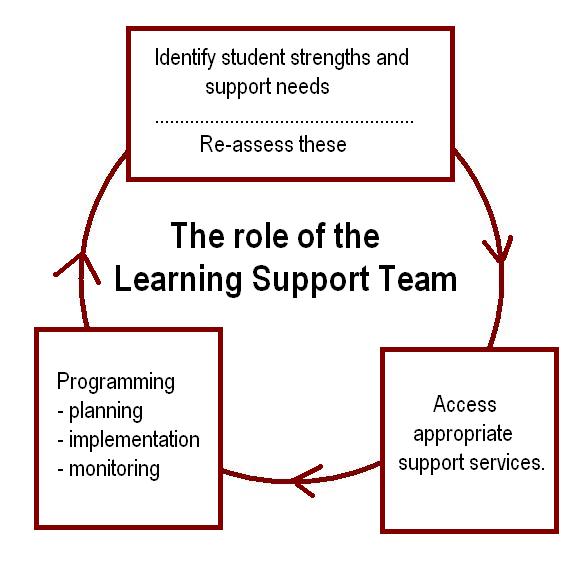
The NSW DET identify the key processes involved in supporting children with disabilities as being a cycle (see image below, adapted from NSW DET, 2008 p12):


The student profile:

The child’s strengths
This might include the student’s interests, abilities, achievements, social networks and skills and so on.

The child’s difficulties or support needs
The way this is done will differ according to the funding policy of your state. For example, in NSW funding is allocated according to the level of need identified under 5 domains: Key learning areas, communication, participation, personal care, movement (NSW DET, 2004).

The key learning areas domain is about identifying the level of support a child may need in order to learn the syllabus outcomes identified in the curriculum. In this area, basic skills such as literacy and numeracy are often the focus.

The communication domain is about identifying the ability of a child to both understand what is said to them, and their ability to convey meaning to others.

The participation domain focuses on two areas: social competence and safety. The team will discuss the child’s level of need in the context of social interaction. And they will also discuss what management strategies may be needed to ensure the child’s safety.

The personal care domain focuses on the child’s support needs in the context of hygiene, eating and dietary needs, and health care procedures.

The movement domain is where the child’s mobility and fine motor skills such as handwriting will be analysed to determine what level of support they may need in these areas.

You can see some profiles of hypothetical children here.

The Learning Support Plan

The learning support plan usually has three key elements: goals, roles and responsibilities, monitoring procedures and a review date.

Priorities and goals:
Based on the child’s profile and identified difficulties, the learning support team usually identify priorities to help guide the child’s education plan. These priorities are then usually written into long term goals for the child. These goals then guide the support strategies and educational program for the child.

Roles and Responsibilities:
To ensure appropriate coordination and implementation of support, the learning support plan usually identifies the roles and responsibilities of team members in relation to each goal.

Monitoring and Review:
Strategies for monitoring the child’s progress towards their goals may also be identified in a learning support plan. This will ensure that the team is accountable for what has been done, and also helps the team review what is working and what is not. Ad date is then usually identified for the review of the plan.


Things to remember when collaborating


One of the most difficult things about team work is bringing together different ideas and perspectives. So it is important to remember a few things:

For parents:
You are the "expert" on your child, and what you and they want from education. You should feel free to actively advocate for your child. If you are feeling a bit daunted by the process, bring along someone who will help you in your advocacy role.

However, make sure you are well informed. Being familiar with The Disability Standards for Education 2005 and the state/territory's funding policies and so on will help you in your advocacy role. Groups such as the Strengthening Families service can help with this.

You might also find it beneficial to visit your child’s classroom to get an idea of how it works and what might be practical in the context of space, number of children and resources available.

For schools:
Teachers are the “experts” in curriculum requirements, or the things that children need to learn to progress through school. Executive staff and consultants know about what is practical within the funding and resource limitations. Therapists and medical staff will have very specialist knowledge.

Seeing things from these different perspectives may mean setting priorities is not as easy as it sounds, though these should be significantly guided by parent/caregiver input. So it is important that all parties are flexible and recognise that there is not necessarily and right or wrong answer when it comes to priorities as these should be shaped by the developmental stage of the child, the parent/guardians’ priorities and the combined information from all professionals.

Another issue is that education and medical professionals may find it difficult to stick to using language that people not involved in these fields can understand. This is simply because every profession has its own jargon. So it is okay to ask for something to be explained, or be put in plain English.


Everything that goes on in the LST meeting should be meaningful to and inclusive of all members of the team.


References and links:

Lyons, G. and Kelly, A. (2008). Resources to Support Inclusion. In P. Foreman (Ed), Inclusion in Action, p427-499. Thomson: Australia.

NSW Department of Educatio and Training (2004). Students with Disabilities in Regular Classrooms: Funding Document. Online at http://www.schools.nsw.edu.au/media/downloads/schoolsweb/studentsupport/programs/disability/guidelines.pdf

NSW Department of Education and Training (2008). Who's Going to Teach my Child. Online at http://www.schools.nsw.edu.au/media/downloads/schoolsweb/studentsupport/programs/lrngdificulties/whoteach.pdf


The Commonwealth Disability Standards for Education 2005

Information from the Victorian Department of Education:
http://www.acd.org.au/information/content/Positive%20Education%20Planning/positive_education_planning_individual_learning_plans.pdf
http://www.education.vic.gov.au/studentlearning/studentreports/samples/default.htm

Information from the NT Department of Education and Training: http://www.det.nt.gov.au/students/support-assistance/special-education-disability/disability

Information from the South Australian Department of Education and Children's Services: http://www.decs.sa.gov.au/svpst/default.asp?id=18656&navgrp=1177

ACT information: http://www.det.act.gov.au/school_education/special_education

From Education Queensland: http://education.qld.gov.au/studentservices/learning/disability/index.html

From the Western Australian Department of Education: http://www.det.wa.edu.au/inclusiveeducation/detcms/navigation/statewide-specialist-services/?oid=Article-id-4548025

Read more...

Saturday, October 17, 2009

Helping teachers know your child and visa versa…

One of the things Gina said in her guest blog about Mac’s transition to school was:
“First term was very much about … settling in and literally giving the teachers and aides time to ‘learn how to drive Mac’.”

This is a very significant point when we are thinking about our child’s transition either to school or to high school. As Seefeldt and Wasik (2002) explain, teachers need to get to know the unique strengths and difficulties of their students to make adaptations so they can be included effectively in the classroom. And your child needs to adjust to the new adult or adults that will be a big part of their weekdays for the next phase of their life.

This will take time.

We also need to recognise that the process may take longer and be a little more difficult if your child is transitioning to an inclusive or mainstream classroom rather than a specialist one.


A note for teachers of inclusive classrooms

Including a child with different needs into your classroom can be a challenging task. But here are some things to think about that may help with the process.

1- Collaboration and teamwork
As teachers we are often used to working alone, having full control over what happens in our classrooms. However, when we include a child with a disability we need to be ready to listen, learn and adapt. We can learn a lot from parents about a child’s likes, dislikes, abilities and communication strategies. This is essential information to help us engage the child in the classroom.

We need to be open and willing to learn from specialist staff such as support teachers and speech therapists. For example, you may have a support teacher for integration who will be helping the child make the transition to school or high school. They may have some strategies and ideas for you to incorporate into your lessons. Working with them will play a significant part in helping the inclusion process successful.

Some children will have a teacher’s aide for a certain number of hours per week. Just remember that a teacher’s aide is not a trained teacher. You still have the primary responsibility for curriculum planning and assessment for the child, in collaboration with a learning support team. A teacher’s aide is there to assist you in the day to day implementation of the program and supervision of the child.

For both teachers and parents, Who's Going to Teach My Child is a useful document to help you become familiar with different types of services. It is a document written by the NSW Department of Education.

2- Attitudes
Attitudes play a very big part in the success of inclusion because there will be challenges and the road may be a bit bumpy at first. As teachers we need to retain the following:

- a recognition that it is the right of every parent and child to choose to be educated in an inclusive environment. This is called equal opportunity. You can read more about this in part 4 (p17) of the Disability Standards for Education 2005.

- a realistic, but optimistic view of our abilities. Know what support you can get, but also know that your skills as a teacher can be used for children of all abilities so long as we have a basic understanding of the child’s unique characteristics. This might involve reading about or going to an in-service course to learn about the disability the child has been diagnosed with.

- openness to and respect for ideas and information from parents and other support staff.

- a willingness to creatively and collaboratively problem-solve. This often means prioritising – dealing with one set of difficulties at a time, taking small steps to ensure you and the child are not overwhelmed.

- a sense of humour LoL


Helping teachers get to know a new student

Butt and Cosser (2004) discuss a program established by the Derby City Special Educational Needs Support Service for children transitioning to school. One of the strategies they used to help teachers get to know students with special needs who were transitioning into their classroom was a personal passport.

They stated that these passports could be in the form of a simple notebook, or a small pocket photo album. The smaller, the better as this could mean that a teacher can carry it around and show it to all other teachers and staff who will need to interact with the child on the playground, in the library, on assembly, at the canteen and so on.

The elements of this passport included:

Child’s name and title page – a photo can ensure easy recognition by school staff as they work on the playground etc.

Important things about me – This information is important to ensure health and safety issues are addressed, or staff are aware of things that could help calm a child if they are upset.

Family and friends – again, photos might be helpful. Identifying siblings or peers attending the school who know the child is important in helping the child settle in and feel safe in their new environment.

Things that make me happy and how I show you
Things that may upset or frighten me and how I show you
What I need to help me understand what you are saying
Systems of communication
– These four elements are about understanding the triggers and functions of the child’s behaviour. For many children this is essential information to assist in preventing explosive behaviour or melt-downs. It can be a key tool in ensuring a peaceful, smooth-running day. Being able to effectively communicate with a child is essential, so we need to understand if they have different ways of communicating.

Things I am learning to do by myself
Things that are rewards for me
- knowing the student’s abilities and strengths give the teacher a starting point for working with the child. It ensures that they have realistic but high expectations for the child. It also means that they will use rewards that the child will respond to, the only really effective reward.

A profile of the child is often developed by a learning support team and presented in different formats. However, we need to ensure that the information in the profile is presented to all the people who need to know, is positive and not labelling or demeaning the child, and is easy to read.

That is perhaps why a personal passport has become so widely used in some countries/counties. It has all these characteristics. It can also be adapted for any age group (below is an example from http://www.allenshea.com/AllStatesPassport.pdf). And it is something that a teacher could do with a whole class if they wanted to do a get-to-know-you exercise to promote empathy and inclusive behaviour.


Helping a student get to know their teacher

As with the familiarisation with the physical setting, photos are one of the most effective tools to help children identify and get to know their new teachers (Butt and Cosser, 2004).

As soon as you chose a school, start developing a photo book of the important adults your child will need to get used to and trust. You might not know who your child’s teacher may be – sometimes the school doesn’t know until the final sorting of enrolments just before school starts. So start with people like the principal. Then, as soon as you find out who they are, add the child’s teacher and teacher’s aide.

If your child is going to a mainstream high school, they will need to get to know a range of teachers. One way of helping your child recognise their teachers, when they will be interacting with them etc is by using photos, folders and colour-coding.

For example, Mr Sims is your child’s Maths teacher. You have a red folder for Maths. On the child’s timetable, Maths is coloured in red. Just inside the front cover of the Maths folder, stick a small photo of Mr Sims. If your child has good literacy skills and has met the teacher before, then a photo may not be important. It may just be a matter of writing the teacher’s name inside the folder with the times and rooms where Maths occurs.

Meeting the teacher

Try to set up meetings between your child and their teacher before the school year starts. Most schools have orientation visits – but one visit may not be enough. And in many cases the Kindergarten teacher will change from year to year. So orientation visits to the classroom will help the child experience the environment, but won’t necessarily help them get to know their teacher.

So, if your child is transitioning to school, along with the photo book you should try to set up meetings between your child and their teacher before they attend school. You might ask to visit the playground when they are on playground duty. You might ask to visit their classroom, even if they are not teaching Kindergarten that year. And, hopefully, the teacher should be invited to any meetings you have with the school to discuss your child’s transition so that you can get to know them as well.

The transition to high school is a bit different due to the range of staff that might be working with your child. So it is best to find a staff member who can be a mentor for your child. For example, the year advisor. This staff member is responsible for the pastoral care of a particular grade. If, on meeting this staff member, you can see that your child is going to respond well to them, then they may be a great mentor for your child.

A teacher-mentor can be someone to whom your child can go whenever they are feeling uncomfortable. So it would be important to:

- Set up a few informal meetings between your child and the staff member before the school year starts. That staff member may be the one who helps to show the child around the school.
- If possible, supply your child with that staff member’s timetable or a way your child can find them whenever needed once school starts. For example, it may be agreed that your child goes to the front office when they need help, and the administration staff contact or help the child find the teacher-mentor. This procedure would need to be discussed and perhaps clarified in a note supplied to the staff working in the administration office.

For your information, here are the NSW DET guidelines on mentoring.


So, in conclusion, helping children get to know their teachers and visa versa is again about starting as soon as you can, using photos, sharing information and recognising that there will be a period of time that will be a bit “bumpy” as everyone gets used to each other.


References:

Butt, A., and Cosser, C. (2004). Supporting transition: Preschool setting into first placement. In M. Blamires and J. Moore (Eds), Support Services and Mainstream Schools, p 68-77. David Fulton Publishers: London.

Seefeldt, C. and Wasik, B.A. (2002). Kindergarten: Fours and Fives go to School. Merrill Prentice Hall: Ohio


.

Read more...

About This Blog

You are welcome to browse as you like... but please remember that everything here is copyrighted. To receive printable copies of articles that you can hand out to others, subscribe to the Learn to be Buddies newsletter at www.learn2bebuddies.com.au

Copyright Amanda Gray 2009-11


  © Blogger templates The Professional Template by Ourblogtemplates.com 2008

Back to TOP