For posts on bullying, visit The Learn to be Buddies Series Blog.
All images and posts written by and copyright to Amanda Clements (nee Gray) 2009-2012 unless otherwise indicated.
Showing posts with label hearing impariment. Show all posts

Wednesday, November 25, 2009

Graphic Organisers: An example of a "least intrusive" adjustment

Graphic organisers are one of the best examples of an adjustment that can be made for students with disabilities whilst also benefiting all other students in their class.

What is a Graphic organiser?

Graphic organisers are things like tables, diagrams, flow charts, checklists. They can be used to visually represent the link between ideas, or the steps in a process. You can find many examples of graphic organisers at teach-nology.com or education.oasis.com

How would you use a Graphic organiser?

Lesson plans:

Graphic organisers can be used as lesson plans to help children be organised and stay on track....
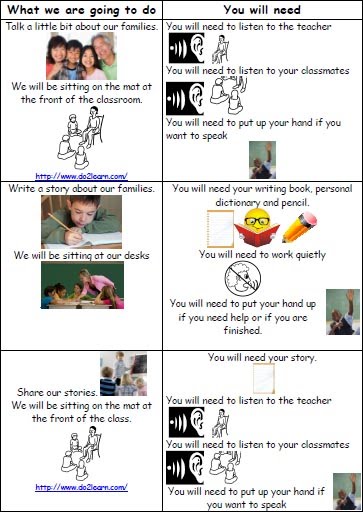


images from Microsoft clipart and www.do2learn.com

This would be important for a student who has attention and organisational difficulties such as ADHD, Autism, Down Syndrome, Bi-polar disorder and so on. However, something like this could be hung out the front of the room and used for the whole class as it could benefit all students.

Concept maps

These are very helpful to help children with recognising relevant vocabulary, as well as helping them to create links between ideas - which is an important process in learning and remembering things. They can be as simple or as complex as appropriate to the age of the child. They could also be made with pictures and words, or just pictures as well.


Writing and reading scaffolds

Graphic organisers are a great way to help children who struggle to organise their thoughts. It can help them write more coherent, longer stories or essays.

Giving a child who is struggling with literacy a story map before they read a story can also help them focus on the meaning of a story rather than just decoding the words on the page. Having a sense of how the story fits together. This will help them read more fluently as knowing what is going to happen gives children struggling with literacy a better chance of making correct "informed guesses" about any unfamiliar words on the page - a process we all use when reading, especially when we don't want to interrupt the flow of the story.

Story maps can be simple or complex. They can be used for children of all abilities, though you should never force children to use them as many children who are very creative, or gifted in story-writing, work best when they can just let the story flow from their pen. So the "least intrusive" use of story maps would be to use them in demonstrations and introduction to topics and stories, and then making them available for those who want to use them in their writing tasks.

For factual texts, KWL charts are a good way of activating interest and prior knowledge of a child. This can be very helpful for children with ADHD and Autism as it can help them become interested in the topic.

Simple or more complex main idea charts can help students organise their thoughts when they have to write assignments or essays on topics. These can be used in a similar way to story maps.


Instructions

We have probably all used checklists at one time or another. Checklists are another example of how graphic organisers can be used. Instructions can also be represented in a series of pictures - which is important for any child who is struggling to hear, remember or read instructions.


Rules for Using Graphic Organisers

Blaxendall (2003) discusses the benefits as well as the pitfalls of using graphic organisers. He suggests successful use of graphic organisers comes down to three things:
  1. Consistency: Regularly using the same set of organisers. This helps children get used to what each type of organiser is used for and what they symbolise.
  2. Coherence: Don't put any irrelevant information in an organiser - it is for important information only. Keep it simple.
  3. Creativity: Use them in as many situations as possible (classwork, homework, group work). Use pictures as much as possible, ensuring that they are age-appropriate and specifically relevant to the content of the organiser.

Reference:
Blaxendall, B. (2003). Consistent, Coherent, Creative: The 3 C's of Graphic Organisers. Teaching Exceptional Children, 35(3), p47.


.

Read more...

Tuesday, September 15, 2009

Teaching social language

Repetition and consistency is very important. Repeat things as often as you can so that she learns the association between the object and the sound. It may take a very long time, with seemingly constant repetition of simple words and ideas, but it really important that you persist. Try to be consistent with the words you use for objects; for example, decide on your family word for toilet/loo/lavatory/bathroom.” (Newman, 2004, p107).


When I first met Isaac* I was warned that I would have to look out for him. He was very rough with other children, pushing, shoving and grabbing toys. I was told that all the disciplinary measures (eg time out, praise, encouragement) were not working. And staff at his preschool were concerned because he was due to go to school next year.

Isaac had a cochlea implant, implanted when he was two years old. Having a cochlea implant does not mean that the child is then “cured” and everything is fine. There will be some delay in terms of language experiences and vocabulary learning missed in the very early years. Further, while a cochlea implant enables a child to hear, it does not act in exactly the same way as our ears (Moore, 1997). For children learning to “listen” with cochlea implants it can be hard to differentiate between important sounds (eg. the words of someone talking directly to you) and unimportant sounds (someone talking close-by or other background noises).

So Isaac had difficulties with learning how language worked in social situations. He saw children sharing, children joining in each other’s play, children interacting. He wanted to be part of this. But he wasn’t picking up the important phrases that made the play work. The give-and-take of social language was difficult for him to catch. It was too quick, there was too much background noise and movement to distract him, and the actual words used weren’t always the same.

So instead of asking to share toys, he would take them. To him, it looked like this is what other children were doing.

Instead of asking if he could join in a game, or call a child’s name to get their attention, he would bump into them, or pinch them, or hit them. Not to hurt, but to get their attention.

And, while he was told not to do this, he didn’t know any other way to achieve the same thing. And his speech was often hard to understand as he was still learning how to articulate them clearly.

But, taking ideas from his speech therapist and early intervention teacher, we worked out a way to help change Isaac's behaviour.

Whenever Isaac went to barge into children’s games, we would jump in and follow this routine:

- Stand beside Isaac and draw his attention by putting a hand on his arm.

- Draw his attention to your mouth by first putting your open-palmed free hand to his chin, then bringing it back to your chin.

- Model how to get another child’s attention by looking at them and calling their name.

- Get Isaac to mimic this by bringing your open-palmed hand to his chin and saying, “Your turn!” and repeating the name.

- Repeat the process until the peer responds (use a physical prompt like tapping the peer on the shoulder to speed up the response if Isaac is beginning to lose interest).

- When the peer looks at Isaac (or yourself), bring Isaac’s attention to this by using the open-palm gesture as described previously.

- Then get Isaac to pay attention to your mouth using the open-palmed gesture.

- Model the words, “[peer’s name],Can I play?” [use exactly the same words every time]

- Get him to repeat this through the same process identified above

- Then get him to repeat it again whilst making eye-contact with the peer by drawing his attention to them using the open-palm gesture, then repeating the phrase, “[peer’s name], can I play?” and then saying, “Your turn!”

- Give lots of praise for his attempt, encourage the peer to respond.

- Wait until the child responds (help Isaac to wait and listen by cupping your hand around your ear and maintaining eye contact with the peer – whilst maintaining your hold on Isaac’s arm :) ).

- If the child says, “Yes” help Isaac get involved in the play appropriately. If the child says, “No” re-direct Isaac to a different game. This will be a natural reward for his language attempts.


This process took a little while for Isaac and his peers to get used to, but we persisted and did the same thing all the time, with specific care to keep the words and gestures exactly the same. This repetition helped Isaac understand.

And we were amply rewarded.

One day I was watching and playing with the children on the playground and distinctly heard Isaac say, “Can I play?” I watched as he persistently repeated this and kept moving to where his peer could see his face until the peer responded. Luckily, the answer was, “Yes”. And Isaac joined in with no help from an adult.


*While this story is built from my experiences with children who have hearing impairments, the names and some details have been changed.


Reference:

Moore, B.C.J. (1997). An Introduction to the Psychology of Hearing. Academic Press: San Diego.

Newman, S. (2004). Stepping Out: Using Games and Activities to Help Your Child with Special Needs. London: Jessica Kingsley Publishers.

Read more...

Sunday, August 16, 2009

Violence in the Media and aggression…

Over many years, there has been a debate raging around this issue. I don’t want to enter into that debate here, but I do want to talk about the things we need to consider when we are making decisions about what our children watch or what video games they play.

How might aggressive behaviour develop?

There are a number of theories about the development and occurrence of aggression across different stages of child and youth development. Kirsch (2006) provides a good overview if you want to read more. However, here I just want to quickly summarise these.

Some children may be more wired towards aggression
This has to do with personality characteristics and the outcomes of disorders such as Autism, Attention Deficit Disorders and Developmental Delays. These children aren’t necessarily going to act aggressively, but due to impulsivity, difficulties with problem-solving or other aspects of cognition they are at higher risk of developing aggressive behaviour depending on what they see, hear and experience.

We learn many social skills by observing

What we see and hear has a great influence on how we behave. It influences our sense of what is “normal” and acceptable. So if we are constantly seeing others act aggressively, whether in real life or in the media, we are more likely to accept this behaviour as “normal”. We may even start behaving more aggressively. This has been described as de-sensitisation.

The other effect is that we can develop a different definition of what constitutes aggression or unacceptable behaviour. This may lead to us not responding in the same way to aggressive behaviour in others. So if I am exposed to swearing and the yelling of derogatory comments regularly, I am less likely to feel that I am being treated unfairly or being bullied when someone yells and swears at me. And while it does not necessarily follow that this behaviour does not affect me emotionally, it can mean I don’t defend myself or communicate to the other person that this behaviour is unacceptable.

Our experiences reinforce what we see
What we experience in our lives, and what those who we trust and love do around us, can influence whether we take on what we see. For example, Kirsh discusses research that suggests that the effects of what children see in the media can be increased or decreased through discussions with teachers and parents. For example, what children learn from educational shows or documentaries is increased if teachers or parents explicitly discuss the content of the shows with them. On the flip side, the effects of a scary movie can be reduced by the presence of an adult if that adult makes the child feel safe. And violence in the movie can be put into perspective through discussion of social values and/or the difference between real life and what they have seen.

Aggression may not be evident immediately
In some cases, the influence of violent media can be evident immediately. For example, when I was working in a child care centre there was definitely an increase in children playfully or intentionally hurting each other with “karate” moves during the “Ninja Turtle” craze. For the most part this behaviour could be shaped and changed through discussions and behaviour modification techniques, but for some children it became a significant bar to their relationships with their peers.

However, it is the more long term effects that we can’t predict and are less likely to be able to manage. For example, the American Psychological Association (2003) reports on a 15 year study of 329 people which showed that children who watch a lot of violent media early in life are at greater risk of becoming physical in domestic arguments, or having been convicted of crimes.

There is also the concern that children who have a tendency towards aggression may enjoy watching it, which in turn could lead to a warped view of what is acceptable and what is not.

Triggers for aggression
So if a child comes to think of aggression as being part of life and an acceptable way of dealing with problems, they are more likely to have a physical response to social problems such as arguments, debates, insults, frustration and anger. It is the latter emotions that bring about aggressive behaviour.

What we need to consider for children of differing abilities

Taking things literally
We need to be especially thoughtful about what our children watch if they tend to take things literally. For example, children with intellectual disabilities may find it very difficult to understand that there can be a dual set of values – one for “real” relationships, and one for the shows they watch. They may take statements or modelled behaviour in the media literally. So watching on thing, then hearing another from their parents or teachers, can be a very confusing experience.

Children who have Autism and Aspergers may also struggle with this as they also tend to have a very literal, black and white view on the world.

Difficulties with self-management
Children who have difficulty thinking about consequences or the effects of their actions on themselves or their peers before they act can also be at greater risk of being influenced by repeated exposure to aggression in the media. For example, children with ADHD often act impulsively in response to their feelings due to the difficulty with executive function (see previous post). So they need extra support to get into the habit of controlling their behaviour. Repeated viewing of uncontrolled or inappropriate behaviour could mean that this behaviour becomes habitually seen as acceptable.

Ongoing frustrations and feelings of failure
Children with a wide range of difficulties, including physical and sensory disabilities such as cerebral palsy and vision or hearing impairments, experience many frustrations and challenges throughout the day. They may find themselves tired or unable to effectively communicate what they know, want or need to others. The way they respond to these feelings is not only shaped by their natural, impulsive response. It is shaped by what methods they have learnt to deal with this situation. So, again, if they are seeing inappropriate models in the media, it may influence their behaviour.


Conclusion

So while the media can’t necessarily be blamed for aggressive behaviour, it can be a contributing factor. And for children with differing abilities, we need to make sure that all our hard work teaching positive social skills isn’t being weakened by repeated exposure to media that communicates contradictory values and inappropriate approaches to problem-solving.

So when you are deciding on media use in your family or classroom, consider the content in the context of the values and skills you want your children to learn. Also consider how much/how often they view movies, videos, TV shows and play computer games. And, finally, consider whether they do it unsupervised and how much you talk to them about the content they have seen. Because, in the end, the values and social skills you model and communicate to your child will be a significant factor in helping them process the information in a balanced way.


References:
Kirsh, S.J. (2006). Children, Adolescents, and Media Violence: A Critical Look at the Research. London: Sage Publications.

American Psychological Association. (2003). Childhood Exposure to Media Violence Predicts Young Adult Aggressive Behaviour, According to a New 15-Year Study: Children Who Identify with Aggressive TV Characters and Perceive the Violence to be Realistic are Most at Risk for Later Aggression. Retrieved 16h August from:
http://www.apa.org/releases/media_violence.html

American Psychological Association. (2004). Psychologists Help Protect Children from Harmful Effects: Decades of psychological research confirms that media violence can increase aggression. Retrieved 16h August from:
http://www.psychologymatters.org/mediaviolence.html

Want to read more:
http://spil.medieraadet.dk/upload/04a_melb.pdf This is the best article. I recommend reading this.
http://ultimateparenting.com/pdf/violence_in_the_media.pdf

http://www.commonsensemedia.org/impact-media-violence-tips
http://www.media-awareness.ca/english/issues/violence/effects_media_violence.cfm
http://www.youngmedia.org.au/mediachildren/index.htm
http://www.psychologymatters.org/videogames.html
http://www.psychology.iastate.edu/faculty/caa/abstracts/2005-2009/07BA.pdf

Read more...

Saturday, May 16, 2009

Do you understand what I'm saying?

Image from "Dave is Brave" www.learn2bebuddies.com.au . Copyright Amanda Gray and Daniel East.


Jenny has just arrived home from the gym feeling stiff and sore. Tom has just come inside as the coldness of the evening has made it too uncomfortable to work any longer in his garden.

Jenny rubs her lower back. “Uhhh! I feel old!”

“Brrr. I’m freezing, too! I’m going to have a shower.”

Jenny watches him go with a perplexed look on her face. “What?”

Image from

Interpreting

Even if we hear what a person is saying, and are paying attention, sometimes we don’t correctly interpret what they are saying.

To interpret or work out what a person is saying you have to be able to make sense of the sounds you hear. You need to change the isolated sounds into words, then put those words together based on their sequence and how they are said to get the full meaning of what you have been told (Anderson, 2000).

Minor misunderstandings like that between Jenny and Tom can occur because of trouble hearing. But they also often occur because we all bring our own ideas or context to communication.

Jenny’s context was that she was sore and tired. Tom’s was that he was cold. So he interpreted the word “old” to mean “cold”.


What makes it hard to interpret sounds?

The size of your vocabulary
You need to share the same vocabulary with the person to whom you are talking (Anderson, 2001). Children can have a smaller vocabulary for a wide range of reasons. Children with developmental delays such as that associated with Down Syndrome may take longer to learn words in a way that means they can “retrieve” them easily. This means that they may have a smaller vocabulary (Buckley, 1993; Chapman, 2006).

We pick up most of our vocabulary through experiences with language and conversations (Cross, 2001). Children who have difficulties hearing will have smaller vocabularies due to limitations placed on their language experiences. Children for whom English is their second language will also have a smaller vocabulary.

Some conditions like dyslexia can influence how we process sounds (Stein, 2001). So while children with these conditions may be able to hear the sounds, it might take them longer to work out what these mean. These children may also have a smaller vocabulary, or mix up sounds more often. They may also struggle to hear changes in tone of voice, which will be discussed below.

Children who have Autism Spectrum Disorders may also have a smaller vocabulary. This is mainly due their limitations in social and emotional reciprocity, or empathy (Scott, Clark, Brady, 2000). This means that the motivation for their communication will come from their own interests, not based on an understanding of how communication influences their relationships with others (Autism Association of South Australia, 2009).

For example, a child with Aspergers may have a special interest in Maths and logical problems. This child may then have a big vocabulary relating to this subject. But in the context of other subjects, including language related to everyday tasks and social interactions, their vocabulary might be quite small.

These difficulties can also lead to problems with the other things you need to know in order to correctly interpret what people are saying (discussed below).

Your knowledge of the patterns of language
To understand what people are saying you need to have a good knowledge of how words fit together in a sentence. You also need to know how tone of voice can change what they mean. As discussed in a previous post , this can be difficult if you have trouble paying attention to and interpreting others’ facial expressions and body language.

Your knowledge of the subject being discussed
As mentioned previously, knowing the context of a discussion is important in helping us interpret what is being said (Anderson, 2001). It helps us put the sounds together and chose the right words to fit the context. It also speeds up the process of changing the sounds into meaningful sentences.

So if you have a child who is tired, or bored, or struggling to pay attention they are more likely to misinterpret what you are telling them to do.


The process of interpreting sounds and words relies on our skills in remembering and retrieving information we have learnt (Hick, Botting & Conti-Ramsden, 2005). I will talk more about memory in the next post.


References:

Anderson, C. (2001). Pragmatic Communication Difficulties. In R. MacKay and C. Anderson (Eds), Teaching Children with Pragmatic Difficulties of Communication, p24-38. David Fulton Publishers: Hampshire.

Autism Association of South Australia. (2009). What is Autism? Retrieved 16th May, 2009 from:
http://www.autismsa.org.au/html/disorders/autism.html


Buckley SJ. (1993) Language development in children with Down syndrome - Reasons for optimism. Down Syndrome Research and Practice,1(1), p3-9. Retrieved from
http://www.down-syndrome.org/reviews/5/

Chapman RS. (2006). Language learning in Down syndrome: The speech and language profile compared to adolescents with cognitive impairment of unknown origin. Down Syndrome Research and Practice, 10(2), p61-66. Retrieved from
http://www.down-syndrome.org/reports/306/

Cross, L. (2001). Early Communication Development. In M.S. Lue (Ed.) A Survey of Communication Disorders for the Classroom Teacher, p35-54. Allyn and Bacon: Boston.

Hick, R.F, Botting, N., and Conti-Ramsden, G. (2005) Short-term memory and vocabulary development in children with Down syndrome and children with specific language impairment. Developmental Medicine & Child Neurology, 47, p532–538. Retrieved
http://journals.cambridge.org/download.php?file=%2FDMC%2FDMC47_08%2FS0012162205001040a.pdf&code=7abb5653813d8fc667d2aaa56a4c8e16

Scott, J., Clark, C., and Brady, M. (2000). Students with Autism: Characteristics and Instruction Programming. Singular Publishing Group: San Diego.


Stein, J. (2001). The Neurobiology of Reading Difficulties. In M. Wolf (Ed) Dyslexia, Fluency and the Brain, p 3-22. York Press: USA.

Read more...

Friday, May 15, 2009

Are you LISTENING?


John is boring on, once again, about the latest movie he has seen. He is retailing, in the greatest unnecessary detail (including quotes), the most exciting parts – all of which mean that your intention to see the movie next week is, well, redundant.

But all the sudden there is an ominous silence. It dawns on you that John has asked you a question… and while you heard what he said, you weren’t actually listening.

You frantically search in your memory… but, no, it’s not there.

You may have to admit it…but, instead, you tell a little white lie.

“Sorry, John, I didn’t hear you.”

Unfortunately John knows that is not strictly true. He walks away in a huff, knowing that the reason you didn’t “hear” is because you mentally tuned out.

Picture copyright Daniel East and Amanda Gray. From picture book, "Dave is Brave" www.learn2bebuddies.com.au
To listen, you have to pay attention

To be able to do what someone asks, you have to be paying attention. You have to not only hear what the person said, you also have to concentrate and focus on the relevant information (Hagemann, Hay & Levy, 2002; Moore, 1997).

You have to be able to shut out all the unimportant things happening around you… like the person mowing the lawn just outside the window. Or the pretty, colourful bird that just flew past. Or the music playing, or people talking, or the TV going in the background (Neven, Anderson & Godber, 2002).

This takes effort. It is also a skill that is more difficult under certain conditions.

When is it hard to pay attention?


There are many reasons why a child may be struggling to pay attention. For example, a child with a hearing impairment or any other language difficulty can miss any words or sounds that cue other children into the fact that you are about to give them a list of instructions.

For example, you might call a child’s name, or say to a class, “NOW (pause to wait for all eyes to turn to you)… what you have to do is…” This is a verbal cue to get your student’s attention. This will only work if the child is “tuned in” to your voice.

It is not only children with hearing impairments who might find it hard to be tuned in to your voice. Children with attention deficit disorders such as ADD or ADHD may find it difficult to focus on one thing if there are lots of other things to look at or listen to (Kewley, 2005; Neven, Anderson & Godber, 2002).

Children who are tired, hungry, anxious, or simply not interested in what you are saying will also find it hard to pay attention to what you are saying.

I will talk about strategies later in another post, but it is important to remember that triggering the child’s attention through more than one sense (touching their shoulder or standing close to them as well as calling their name) may be the answer.

And always, always, make sure you have their attention first before you start asking them to do things (Educational Psychology Service, 2008).

How can you tell if they are paying attention?

Eye contact is one of the most important things to gain before giving instructions. This will tell you that the child is focusing their attention where you want it. It will also help those who struggle with storing the words or hearing the sounds as they can get clues about what you are saying through your body language, gestures, lips and facial expressions (Queensland Health, 2008).

For children with Autism for whom eye contact may be difficult, do not demand eye contact (Austism SA, 2004). Looking in your direction or tilting their ear towards you may be their way of paying attention.


In the next post I will talk about difficulties children might have in interpreting what we are saying.

Reference list:

Autism South Australia. (2004) Information Sheet 17 Classroom Issues. Retrieved 15th May, 2009 from:
http://www.autismsa.org.au/pdf/strategies/IS17_Classroom_Issues.pdf

Queensland Health (2008). Communication with vision or hearing impaired clients. Retrieved 15th May, 2009 from:
http://www.health.qld.gov.au/sop/content/comm_vision_hearing.asp

Kewley, G. (2005). Attention Deficit Hyperactivity Disorder: What can Teachers Do? David Fulton Publishers:London.

Neven, R.S., Anderson, V. and Godber, T. (2002). Rethinking ADHD. Allen and Unwin: Crows Nest.

Hagemann, E., Hay, D.A., and Levy, F. (2002). Cognitive Aspects and Learning. In S. Sandberg (Ed), Hyperactivity and Attention Disorders of Childhood, p214-241. Cambridge University Press: Cambridge.

Moore, B.C.J. (1997). And Introduction to the Psychology of Hearing. Academic Press: San Diego.

Educational Psychology Service. (2008). Managing Attention Deficit Hyperactivity
Disorder (ADHD) in the Classroom. Retrieved 15th May, 2009 from:
http://www.falkirk.gov.uk/services/education/information_for_parents/PDFs/psychology_service/adhd.pdf

You might also want to check out the following links:
http://www.det.wa.edu.au/education/abled/docs/RICPubClassIdeasK3.pdf
http://www.decs.sa.gov.au/wakefield/files/links/Classroom_Strategies_Accom.doc
http://www.austinschools.org/lifeskills/Classroom%20Management.pdf
http://www.hearing.com.au/communication-tips

Read more...

Sunday, May 10, 2009

Why aren’t you listening? Disobedient or Distracted?

Picture copyright Daniel East - from "Dave is Brave" www.learn2bebuddies.com.au
“I’ve told him what to do a dozen times, but it goes in one ear and out the other!”

Have you ever heard that said? Well, it might be very near the truth.

But, despite what you might feel, a “good kick up the backside” is not the solution. We need to understand why our words have not stuck with the child.

What is involved in doing what you are told?

When you are told to do something you have to be able to hear, listen, interpret, remember and act on the instructions. If you have difficulties doing any one of these things you can seem “disobedient”.

In this post I want to talk about hearing.

Hearing

I won’t give you a biology lesson on hearing here. You might want to visit the Mayo Clinic if you are interested in how the ear works. For now, I just want to point out some reasons why a child might not be able to hear you.

Conductive hearing loss (ASHA, 2009; Australian Hearing, 2009; Moore, 1997)

Children who have recurring ear infections such as Otitis media, or even a build up of wax in the ear will find it hard to hear clearly. For others the bone and cartilage structure may interfere with the movement of sound through the ear to the nervous system that processes the sounds.

Children with Down Syndrome are shown to be at increased risk of ear infections and conductive hearing loss because of their susceptibility to infections and the smaller ear canal (Moss, nd).

Indigenous Australians have also been shown to be at increased risk of conductive hearing loss (Coates et al).

For some children, the treatment might be through antibiotics or grommets (MyDr, 2008). For others, hearing aids may be used.

Sensorineural hearing loss (ASHA, 2009; Australian Hearing, 2009; Moore, 1997):

This is when the cochlea or the nerves that carry sound to the brain might be affected. The levels of hearing loss may differ, but generally sensorineural loss cannot be fully addressed even if the child is using hearing aids. For children whose cochlea is damaged, cochlea implants can be used. For others, communication will be through the use of sign language.


The levels of hearing loss are described as mild, moderate, severe and profound. If you want to know what a child might hear depending on the level of hearing loss they have been diagnosed with, visit ASHA and the Medical College of Wisconsin (they have a great picture that is easy to understand). The Warren Centre also has a good diagram of what sounds equate to different decibel levels (as seen in the ASHA description).

Disobedience or Distraction?

If a child has an ear infection such as Otitis Media they will struggle to hear you call their name in a noisy room or if their back is turned to you. So if they don’t respond, it is that they haven’t been able to pick out your voice from all the other noises going on around them.

If a child has a hearing aid or a cochlea implant, it doesn’t mean that they have perfect hearing. They will struggle to hear you in noisy rooms, or if there is something or someone making a noise closer to them than you.

You also need to remember that children with hearing impairments may have smaller vocabularies and may struggle with understanding how sentences are put together. This is because their learning of language is interrupted by what they can and can’t hear. This may mean they find it hard to pick out the important bits in your instruction.

For example, if you say "Julie, can you put your book away in your book tray, please?" the child
may know you have mentioned a book and a tray, but not make the connection between the two. So the child may be confused about what exactly you want them to do with the two objects.

Next Time

In the next post I will talk about the difference between listening and hearing. Later I will also talk about some strategies and things to think about when giving instructions to a child who has a hearing impairment.

References
Australian Hearing (2008) Types of Hearing Loss. Retrieved 10th May, 2009 from:
http://www.hearing.com.au/types-of-hearing-loss

American Speech-Language-Hearing Association. (2009). Type, Degree and Configuration of Hearing Loss. Retrieved 10th May, 2009 from:
http://www.asha.org/public/hearing/disorders/types.htm

Coates, H.L., Morris, P.S., Leach. A.J., and Couzos, S. (2002). Otitis media in Aboriginal children: tackling a major health problem. Medical Journal of Australia 177 (4): 177-178 Retrieved from: http://www.mja.com.au/public/issues/177_04_190802/coa10271_fm.html


Mayo Clinic (2009). How do we Hear? Retrieved 10th May, 2009 from: http://www.mayoclinic.org/hearing-disorders/how.html

Moore, B.C.J. (1997). An Introduction to the Psychology of Hearing. SanDiego: Academic Press.


Moss, K. (nd). Hearing and Vision Loss Associated with Down Syndrome. Retrieved 10th May, 2009 from:
http://www.deafblind.com/downmoss.html

My Dr (2008). Otitis Media in Children. Retrieved 10th May, 2009 from:
http://www.mydr.com.au/kids-teens-health/otitis-media-in-children

Read more...

About This Blog

You are welcome to browse as you like... but please remember that everything here is copyrighted. To receive printable copies of articles that you can hand out to others, subscribe to the Learn to be Buddies newsletter at www.learn2bebuddies.com.au

Copyright Amanda Gray 2009-11


  © Blogger templates The Professional Template by Ourblogtemplates.com 2008

Back to TOP