For posts on bullying, visit The Learn to be Buddies Series Blog.
All images and posts written by and copyright to Amanda Clements (nee Gray) 2009-2012 unless otherwise indicated.
Showing posts with label disability Standards for Education. Show all posts

Saturday, July 24, 2010

To Include or not to include?

Special Education - "What's best for kids?" - as on seen on Weekend Sunrise Channel 7


And just as an additional note...

Article 23 of the UN Convention of the Rights of the Child (to which Australia is a signatory):


1. States Parties recognize that a mentally or physically disabled child [child with an intellectual or physical disability] should enjoy a full and decent life, in conditions which ensure dignity, promote self-reliance and facilitate the child's active participation in the community.


...


3. Recognizing the special needs of a disabled child, assistance extended in accordance with paragraph 2 of the present article shall be provided free of charge, whenever possible, taking into account the financial resources of the parents or others caring for the child, and shall be designed to ensure that the disabled child has effective access to and receives education, training, health care services, rehabilitation services, preparation for employment and recreation opportunities in a manner conducive to the child's achieving the fullest possible social integration and individual development, including his or her cultural and spiritual development.


And 4.2 of the
Commonwealth Disability Standards for Education (2005) states:


(1)The education provider must take reasonable steps to ensure that the prospective student is able to seek admission to, or apply for enrolment in, the institution on the same basis as a prospective student without a disability, and without experiencing discrimination.

(2) The provider must ensure that, in making the decision whether or not to offer the prospective student a place in the institution, or in a particular course or program applied for by the prospective student, the prospective student is treated on the same basis as a prospective student without a disability, and without experiencing discrimination.

(3) The provider must:

(a) consult the prospective student, or an associate of the prospective student, about whether the disability affects the prospective student’s ability to seek admission to, or apply for enrolment in, the institution; and

(b) in the light of the consultation, decide whether it is necessary to make an adjustment to ensure that the prospective student is able to seek admission to, or apply for enrolment in the institution, on the same basis as a prospective student without a disability; and

(c) if:
(i) an adjustment is necessary to achieve the aim mentioned in paragraph (b); and
(ii) a reasonable adjustment can be identified in relation to that aim;
make a reasonable adjustment for the student in accordance with Part 3.


If you want to see the Facebook debate, visit http://www.facebook.com/group.php?gid=134329293268218

Read more...

Monday, November 23, 2009

What is a Reasonable Adjustment?

If you are a parent, have you ever been frustrated with what has been done to support your child in an inclusive classroom? Have you ever wondered what limits there are on the types of things that can be done?


And teachers, do you feel you have been asked to do too much? Have you wondered what can be reasonably expected of you when including a student with a disability?


Part 3 of the Commonwealth Disability Standards for Education 2005


Part 3 lays down some guidelines to help learning support teams make the decision about what might be reasonable in terms of adjustments to be made for a student. The criteria centres around the concept that any adjustment made must “balance the interests of all parties affected.” (p10)


But first…. What is an adjustment?


Basically, it is anything that a school and/or teacher do to help a child with a disability to participate and access facilities. It can be anything from using visual schedules to putting in ramps for a child in a wheelchair to employing a teacher’s aide.


Parents


Part 3 states that the decision about adjustments must be made in collaboration with the student and/or their associates. It also states that the student and/or associates’ (ie. parent/caregivers) opinion must be taken into consideration as to whether the adjustments are adequate.


So as part of the learning support team, parents should have a voice in the discussion about what adjustments are appropriate. But as in any advocacy role, we need to make sure we are as well-informed as possible about our options. As stated in the previous post, parents have a right to ask for information and can bring a friend and/or advocate with them when they attend learning support meetings.


One parent I knew got much more support for her child when she brought her privately consulted speech therapist with her to the learning support team meeting. This was primarily due to the fact that the therapist knew a lot more about what the child needed and could provide evidence of that need through official reports and so on.


The student


Part 3 states that the decision about adjustments must take into account the student’s disability. This may seem superfluous, but it is important that the Learning Support Team be well informed about the characteristics of the disability, and also how that disability affects the individual student – as all students are different, even if they do have the same disability.


The adjustments need to support the student in achieving the curriculum learning outcomes, whilst also maintaining the integrity of the course or ensuring that the accreditation standards for the course are maintained. This means that some adjustments will need to be abandoned because they either water-down the content of the courses as specified in the Syllabus documents. Alternatively, they might create a false impression of the child’s capabilities.


For example, students who have intellectual disabilities who are completing the School Certificate or High School Certificate would be completing the Life Skills Certificates. The Life Skills curriculum has been specifically designed for students with intellectual disabilities as it focuses on functional skills, or skills that will help the child succeed in their future life.


It is not a “watered-down” version of the regular curriculum. It is an alternative set of criteria. But it is only accessible to children under strict guidelines as it would be inappropriate for children who can learn the skills contained in the regular Syllabus if given appropriate supports.


For example, a child who is deaf can meet the requirements for accreditation under the Curriculum guidelines if they are provided with adjustments such as an interpreter. Click here for guidelines (Word doc) on who can complete the Life Skills Curriculum.


This brings us to the next point Part 3 makes: That the adjustments must provide adequate support so the child can participate in the educational activities.


The adjustments should also promote the independence of the child. I previously discussed this in the context of teachers aides.


Part 3 mentions that the adjustments should be the “least intrusive” option. The least intrusive adjustments are subtle. They don’t take away a child’s independence or choice. They have minimal effect on the child’s social belonging and status in the classroom. In short, they don’t “intrude” on the child – or their friends - socially or academically as they learn together in the classroom.


For example, let’s say a child is struggling to sit still in the classroom for long periods of time. The most intrusive approach would be to continually correct and re-direct the child. “Johnny, sit down.” “Have you finished your work yet, Johnny?” and so on. This will affect the child’s self-esteem, it could be disruptive to others (perhaps even more so than the actual getting out of the seat), and can lead to a labelling of the child as “naughty.”


A less intrusive approach would be to know the child’s limits, as well as their strengths and work with them. Have clear, visual guidelines like a picture that you put on the board/Smartboard to indicate when it is time to stay in their seat. Use eye contact and pointing to the picture to prompt the behaviour. But also know how long the child is able to sit still. For some children who have ADHD, or cerebral palsy, sitting still for long periods of time can be physically impossible. So occasionally have fun physical breaks, or options for movements like running errands, getting children to bring their work to you for checking or having a one minute “stretch break” every 10 to 15 minutes.


But as the child gets older and has more practice at sitting still, the time they can “last” is likely to increase. Then, as Part 3 states, the adjustments need to be reviewed and changed with the child’s changing needs. This should be the case for all adjustments.


Teacher and students


When making adjustments, we also need to balance the interests of the teacher and students in the classroom.


The concerns of teachers often revolve around their ability to equitably cater for all children in their classrooms in terms of the amount of time they may need to spend with a student who has a disability, answering their questions or managing their behaviour. They may be concerned about the disruption caused by some of the more difficult behaviour, and doubt their ability to deal with that behaviour without extra training. They may also be concerned about extra time and expertise required to plan inclusive lessons and design appropriate materials.


All these factors need to be taken into consideration when planning for inclusion. But it is important to note that we cannot expect zero disruption in inclusive classrooms. Inclusion does come with its challenges, and for some children placement in specialist classes may turn out to be the best option in the context of the resources currently available in our education systems.


However, as reported by Foreman (2008), research does indicate that children without disabilities who learn in inclusive classrooms may develop extra-curricular skills such as respect, value for diversity and social values associated with inclusion that they may not have developed in other classrooms. It also indicates that students not diagnosed with a disability may feel an advantage from the adjustments made for fellow students with disabilities.


So, when choosing adjustments, Part 3 states that not only should we look for the least intrusive option, but we also need to look for the least disruptive option.


So, some examples of what we cannot expect from teachers are:

  • To spend chunks of time one on one with a single student
  • To spend all their time planning adjustments that will only cater to one child


But we can expect teachers:

  • To participate in learning support meetings or collaborate with support staff
  • To spend a reasonable amount of time planning adjustments that are essential to the child’s completion of class tasks


And, teachers, you can get support from specialist staff such as Support Teachers to help you access ready-made resources, or for help in designing appropriate resources for students with disabilities.


When it comes to the challenge of behaviour, you might also want to read this post to hear the perspective of a teacher.


School and Education Departments


In making sure that adjustments are reasonable, school and education departments will also need to look at the available funding and resources. Part 3 highlights that the costs and benefits of every adjustment need to be weighed up. It is important to make all effort to implement the best adjustments, but these need to be realistic in the context of the funding rules and other regulations governing what can be implemented in schools. You can get more information about this from the disability consultant in your local education office.


Finally, whenever a learning support team has decided on a specific adjustment, it is important that it be implemented as soon as possible. As Part 3 indicates, the adjustments should be made available as soon as possible so as not to disadvantage the student in their learning.


So if you are heading off to negotiate adjustments for your child or your student, make sure you keep these things in mind.


Reference:

Foreman, P. (2008). Setting the Scene: Teachers and Inclusion. In P.Foreman (Ed), Inclusion in Action, p2-36. Thomson: Australia.

Read more...
Friday, November 20, 2009

Learning support teams

Thanks to Hilary Clinton, we have probably all heard the old African proverb, “It takes a village to raise a child.” Well, it might also be said that “It takes a team to educate a child with special needs” – not so catchy, but just as true.

What is a learning support team?

A learning support team (LST) is a team of people who coordinate, plan and review the supports available to a child with a disability (Lyons & Kelly, 2008; NSW DET, 2008) . This team should include all those involved in the day-to-day education of the child.

According to the NSW Department of Education and Training (NSW DET, 2008), the people you will usually find on a learning support team include:

  • Parents/caregivers
  • the principal or another executive staff member such as the head teacher for welfare, or assistant principal
  • a class teacher representative (if your child is in an inclusive classroom)
  • the school counsellor
  • a specialist teacher, such as a support teacher or the specialist class teacher if your child is in a specialist classroom.

Other people who may be involved in the team could include a disability programs consultant or itinerant teachers from the Department of Education, a teachers’ aide, or specialist personnel from outside the Department such as a physiotherapist, child psychologist, speech therapist, occupational therapist and so on. Parents can also bring along an advocate, interpreter or other “moral support” in the form of grandparents, friends or family support workers.


What happens in a learning support team meeting?


There may be two types of meetings involving learning support teams in your school (Lyons & Kelly, 2008). The first is a meeting of all learning support staff in the school. This meeting may happen once a week or once a fortnight and does not include parent involvement. These meetings do not focus on any one child, but on the needs of all children with disabilities in the school.

This whole school meeting of learning support staff focuses on items such as:
  • Distributing resources
  • Making referrals
  • Managing case loads
  • Reviewing or sharing information about students

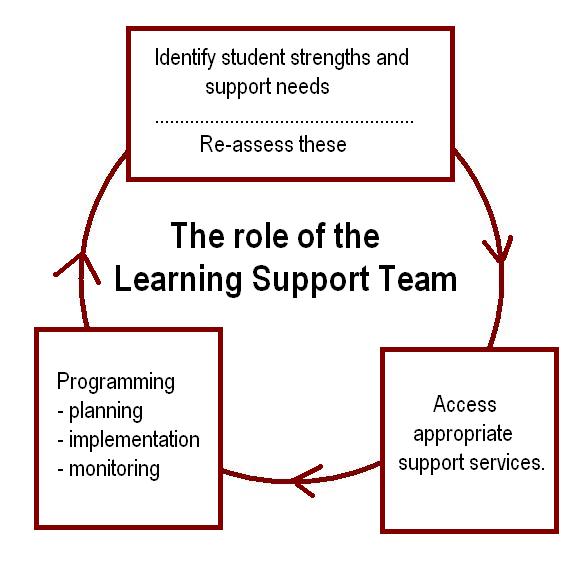
Learning support team meetings focusing on individual students, and involving parents, most often happen once a year. These are usually focused on the processes involved in applying for and reviewing funding and resources. The tangible outcome of the meeting is usually a written profile of the child, a learning support plan and perhaps some completed forms related to funding (see this document)

The NSW DET identify the key processes involved in supporting children with disabilities as being a cycle (see image below, adapted from NSW DET, 2008 p12):


The student profile:

The child’s strengths
This might include the student’s interests, abilities, achievements, social networks and skills and so on.

The child’s difficulties or support needs
The way this is done will differ according to the funding policy of your state. For example, in NSW funding is allocated according to the level of need identified under 5 domains: Key learning areas, communication, participation, personal care, movement (NSW DET, 2004).

The key learning areas domain is about identifying the level of support a child may need in order to learn the syllabus outcomes identified in the curriculum. In this area, basic skills such as literacy and numeracy are often the focus.

The communication domain is about identifying the ability of a child to both understand what is said to them, and their ability to convey meaning to others.

The participation domain focuses on two areas: social competence and safety. The team will discuss the child’s level of need in the context of social interaction. And they will also discuss what management strategies may be needed to ensure the child’s safety.

The personal care domain focuses on the child’s support needs in the context of hygiene, eating and dietary needs, and health care procedures.

The movement domain is where the child’s mobility and fine motor skills such as handwriting will be analysed to determine what level of support they may need in these areas.

You can see some profiles of hypothetical children here.

The Learning Support Plan

The learning support plan usually has three key elements: goals, roles and responsibilities, monitoring procedures and a review date.

Priorities and goals:
Based on the child’s profile and identified difficulties, the learning support team usually identify priorities to help guide the child’s education plan. These priorities are then usually written into long term goals for the child. These goals then guide the support strategies and educational program for the child.

Roles and Responsibilities:
To ensure appropriate coordination and implementation of support, the learning support plan usually identifies the roles and responsibilities of team members in relation to each goal.

Monitoring and Review:
Strategies for monitoring the child’s progress towards their goals may also be identified in a learning support plan. This will ensure that the team is accountable for what has been done, and also helps the team review what is working and what is not. Ad date is then usually identified for the review of the plan.


Things to remember when collaborating


One of the most difficult things about team work is bringing together different ideas and perspectives. So it is important to remember a few things:

For parents:
You are the "expert" on your child, and what you and they want from education. You should feel free to actively advocate for your child. If you are feeling a bit daunted by the process, bring along someone who will help you in your advocacy role.

However, make sure you are well informed. Being familiar with The Disability Standards for Education 2005 and the state/territory's funding policies and so on will help you in your advocacy role. Groups such as the Strengthening Families service can help with this.

You might also find it beneficial to visit your child’s classroom to get an idea of how it works and what might be practical in the context of space, number of children and resources available.

For schools:
Teachers are the “experts” in curriculum requirements, or the things that children need to learn to progress through school. Executive staff and consultants know about what is practical within the funding and resource limitations. Therapists and medical staff will have very specialist knowledge.

Seeing things from these different perspectives may mean setting priorities is not as easy as it sounds, though these should be significantly guided by parent/caregiver input. So it is important that all parties are flexible and recognise that there is not necessarily and right or wrong answer when it comes to priorities as these should be shaped by the developmental stage of the child, the parent/guardians’ priorities and the combined information from all professionals.

Another issue is that education and medical professionals may find it difficult to stick to using language that people not involved in these fields can understand. This is simply because every profession has its own jargon. So it is okay to ask for something to be explained, or be put in plain English.


Everything that goes on in the LST meeting should be meaningful to and inclusive of all members of the team.


References and links:

Lyons, G. and Kelly, A. (2008). Resources to Support Inclusion. In P. Foreman (Ed), Inclusion in Action, p427-499. Thomson: Australia.

NSW Department of Educatio and Training (2004). Students with Disabilities in Regular Classrooms: Funding Document. Online at http://www.schools.nsw.edu.au/media/downloads/schoolsweb/studentsupport/programs/disability/guidelines.pdf

NSW Department of Education and Training (2008). Who's Going to Teach my Child. Online at http://www.schools.nsw.edu.au/media/downloads/schoolsweb/studentsupport/programs/lrngdificulties/whoteach.pdf


The Commonwealth Disability Standards for Education 2005

Information from the Victorian Department of Education:
http://www.acd.org.au/information/content/Positive%20Education%20Planning/positive_education_planning_individual_learning_plans.pdf
http://www.education.vic.gov.au/studentlearning/studentreports/samples/default.htm

Information from the NT Department of Education and Training: http://www.det.nt.gov.au/students/support-assistance/special-education-disability/disability

Information from the South Australian Department of Education and Children's Services: http://www.decs.sa.gov.au/svpst/default.asp?id=18656&navgrp=1177

ACT information: http://www.det.act.gov.au/school_education/special_education

From Education Queensland: http://education.qld.gov.au/studentservices/learning/disability/index.html

From the Western Australian Department of Education: http://www.det.wa.edu.au/inclusiveeducation/detcms/navigation/statewide-specialist-services/?oid=Article-id-4548025

Read more...

Thursday, November 12, 2009

Support Services: What can we put on our wish list?

As this year comes to an end and we start thinking about the next school year (in Australia, at least), it is important to know what support services are available in our school systems. The first thing to understand is the laws and Standards that set the guidelines for supports in schools.


For countries other than Australia

If you are from the US you will need to know about the Individuals with a Disability Act and Section 504 … and maybe more. I have not worked with these, so will not discuss them here. However, you might want to do some reading starting at the Disability.gov site.

If you are from the UK, you might want to start find out about Special Education Needs support by visiting this site: http://www.teachernet.gov.uk/wholeschool/sen/


For Australia
The Commonwealth Disability Standards for Education 2005

Part 7 of these Standards is called the Standards for student support services. Here are some of its main points.


Where do the support services come from?

- Students with disabilities should be able to access support services within the school or Education Department available to students without a disability without discrimination. So it the school is has supports such as a mentoring system, or peer support, peer tutoring or career advisor, children with disabilities should be able to access these services in the same way as all children in the school.

- If a student with a disability needs a specialised support service to ensure that they can participate in learning or other school-based activities, and it exists within the Department of Education, then the Standards state that the “provider must take reasonable steps to ensure that the student has access to the service (but may arrange for it to be provided by another person or agency).” (p19)

- If a specialised support service is needed, and it does not exist within the Department or school, the “the provider must take reasonable steps to facilitate the provision of the service to the student by another person or agency.”


Who decides on what is necessary?

Part 7 identifies that the process of deciding on the nature of the support services needed for the child should include consultation with the student or an associate of the student.

An associate, according to Part 1.4 (p6), is:

“(a) a spouse of the person; and

“(b) another person who is living with the person on a genuine domestic basis; and

“(c) a relative of the person; and

“(d) a carer of the person; and

“(e) another person who is in a business, sporting or recreational relationship with the person.”


So, in the school situation, the Learning Support Team (who I will discuss in another post) should jointly make this decision. And parents and their child (if the child is over the age of 11) should be part of that Learning Support Team.


What services should be supplied?


- specialised equipment: which can mean anything from mobility aids to technology such as that seen on the spectronicsinoz website.

- appropriately trained staff: which usually means teachers’ aides and support teachers.

Part 7 also stipulates that staff should be aware of available support services and be provided with information about these so they can assist students to access these, including through collaboration with “specialised service providers” such as social workers, speech therapists and so on.

In the next few posts I will look at writing more about the roles of teachers’ aides, support teachers, and what might be “reasonable” in the context of funding structures and current resources.


.


Read more...

Tuesday, October 27, 2009

Will my child be bullied? Things to consider when your child moves to high school

One of the things I hear from parents whose children are moving from primary to high school is the concern that their child will be bullied. This often has to do with the physical and social difference between the two environments as highlighted in a previous post. This includes fewer teachers to the number of students – which means less supervision, more freedom and responsibility.

What can we do?

Parents and schools can help protect children, and teach them to protect themselves, by knowing and/or developing appropriate policies and procedures, understanding bullying and helping children develop protective social networks.

Anti-bullying Standards and Policies

It is important that you explore these as they will
- define what is classified as bullying or harassment
- clarify how you and your child can report incidents of bullying
- clarify what actions can be taken in response to bullying

The Disability Standards for Education 2005

The Disability Standards for Education 2005 apply to all people with a disability involved in learning in the whole range of educational institutions Australia-wide. That is, they apply to children in pre-schools right up to University students. Part 8 of these Standards address harassment and victimisation.

It defines harassment as “an action taken in relation to the person’s disability that is reasonably likely, in all the circumstances, to humiliate, offend, intimidate or distress the person” (p22). It states that the Standards of Part 8 are not just about ensuring students with a disability are not harassed, but also their “associates” – such as friends, family, teachers etc.

Under Part 8, all schools are required to have well publicised policies and codes of conduct that identify and prohibit harassment, as well as outlining procedures for reporting bullying and responding to it in a “fair, transparent and accountable” (p23) way.

The Standards also state that schools should be implementing programs and strategies to help prevent harassment.

The NSW Department of Education Anti-Bullying Plan for Schools


This document is relevant to all children in NSW Department of Education Schools, whether they have a disability or not. Similar guidelines should be available from all State and Territory Education Department Websites.

On pages 5 and 6 it defines bullying. This includes the statement that bullying is “intentional, repeated behaviour by an individual or group of individuals that causes distress, hurt or undue pressure” and involves “abuse of power.”

It is important to recognise that your child will have conflicts with peers that may cause them some distress, but may not be classified as bullying. These conflicts will require a different approach than bullying. If you are unsure about this, talk your child and to a school representative such as the Year Advisor or Head teacher for Welfare – or even a teacher who your child knows well. They can help you get all sides of the story – which is very important to any effective conflict management or bullying situation.

Another section of particular interest in this Plan is the responsibilities outlined for students, families, schools and teachers on pages 7 and 8. For students, it includes the responsibility to “behave appropriately, respecting individual differences and diversity.” This is important for two reasons. Firstly, because children who behave inappropriately have been shown to be at increased risk of bullying (Carter, 2006) – so we need to help them learn social skills that will help them avoid this. Secondly, if our children are behaving without respect, it is very hard to ask others to respect them. Thus it is much more difficult to protect them from bullying.

The Plan suggests that the responsibilities of parents and caregivers is to “be aware of the school Anti-bullying Plan and assist their children in understanding bullying behaviour” and “support their children in developing positive responses to incidents of bullying consistent with the school Anti-bullying Plan.

This means that there is one more policy you should be aware of – the school’s discipline or anti-bullying policy. As the Plan states, each school has a responsibility to “develop and Anti-bullying Plan through consultation with parents, caregivers, students and the community, which clearly identified both the behaviours that are unacceptable and the strategies for dealing with bullying in the classroom and playground. I will discuss an example below.

The Plan states the responsibility of teachers is to “respect and support students”, “model appropriate behaviour” and “respond in an appropriate and timely manner to incidents of bullying.”

For more information on all these things, visit https://www.det.nsw.edu.au/antibullying/index.html and http://www.bullyingnoway.com.au/default.shtml

It is also important to recognise that serious harassment outside the school jurisdiction will need to be dealt with by the police or other relevant authorities. You might want to visit http://www.police.nsw.gov.au.

Cyber-bullying is another issue that can be difficult for a school to monitor. For advice and tips on how to help your child be safe, visit http://www.cybersmart.gov.au/ and http://www.talktoyourkids.com.au/


School Anti-bullying and/or Discipline policies: Some Examples

While there will be similarities between school policies, each will be unique to the setting and culture of the school. So make sure that you get a copy of your child’s chosen high school’s policy and keep it on hand throughout their school career.

Here are some school policies you can browse.
http://www.kirrawee-h.schools.nsw.edu.au/05_policies/links/antiBullyingPolicy.pdf

http://www.winmalee-h.schools.nsw.edu.au/htm/info/policies/bullying.htm

http://www.smithshill-h.schools.nsw.edu.au/index/files/Anti-Bullying%20Policy.pdf

http://www.baulkhamhillshighschool.com.au/about/policies/antibullying/

http://www.pennanthil-h.schools.nsw.edu.au/public/2004/policies/discipline/disciplinepolicy.pdf


Set up protective networks

While children going to high school are usually expected to make their own friends, we can do things to help them establish protective social networks – especially if they have disabilities.

The first thing you might be able to do is get your child involved in a club or social activity they really enjoy outside school hours. This could be anything from a swimming club, dancing lessons, chess club, footy team, Scouts, Guides… anywhere they may meet children who share similar interests and who will be attending the same high school. Your local paper or neighbourhood centre might be able to help if you need ideas.

The second thing is that the school and parents can work together during the orientation process to set up a buddy system. Connecting your child with an older, responsible student will mean they have someone to go to if they don’t want to talk to adults but can’t deal with an issue on their own. Make sure these buddies keep in contact and re-contact over the long break before school starts. You might want to set up a pen-pal or email connection.

Another effective resource is siblings, or family friends, or older children your child knows outside of school. They can also become a protective factor for your child.

Observe and Communicate

Having open communication lines with family and at least one teacher will help to ensure any distressing incidents can be dealt with effectively. Families and schools also need to be communicating effectively, with a focus on the child, in order to maintain a safe environment for the child.

Because at high school a child no longer has one primary teacher, schools usually have a representative teacher responsible for supporting each grade. These are usually called Year Advisors. Make sure you know this person, and help your child get to know them as well.

Another person to look for in your school is the Head Teacher for Welfare or Special Education. This staff member will also be responsible for the social and emotional wellbeing of the school’s students.

But just a little note – it is important to first help children try to solve their own conflicts before getting involved.

What to teach your child:

Measor and Fleetham (2005) have written a great book on the transition to high school. It is well worth the read. However, I want to focus on discussing the 5 key steps they suggest your child learn to help them “beat the bullies” – see page 77.

Step 1 – Avoid confrontation and places where you would not be supervised by a teacher. Identify where is it safe to work and play.

Step 2 - Make friends and stay with them and others with whom you feel safe. Go and find them if you are feeling worried or anxious.

Step 3 – Have strategies to deal with bullying. Parents and teachers can use the Mind Matters program or the ideas on Bullying – No Way! to help children with this. But some basic strategies to teach your child might be:
- Walk away… if that doesn’t work
- Ask them, firmly but calmly, to stop … if that doesn’t work
- Find your friends, tell them what is happening so they can help you tell the person to stop… if that doesn’t work
- Tell a teacher, and identify a safe place where you can play until the issue is resolved.

Step 4 – Make sure you recognize when you must speak to an adult. Also, don’t be a bystander. If a friend is being bullied, walk away and tell a teacher.


References

Carter, B.B, Spencer, V.G. (2006). The Fear Factor: Bullying and Students with Disabilities. International Journal of Special Education, 21(1), p11-24.

Measor, L and Fleetham, M. (2006) Moving to Secondary School: Advice and activities to support transition. Hawker Brownlow: Victoria


I have also written a range of posts on bullying which you can find here or by searching for bullying on my blog.


.

Read more...

About This Blog

You are welcome to browse as you like... but please remember that everything here is copyrighted. To receive printable copies of articles that you can hand out to others, subscribe to the Learn to be Buddies newsletter at www.learn2bebuddies.com.au

Copyright Amanda Gray 2009-11


  © Blogger templates The Professional Template by Ourblogtemplates.com 2008

Back to TOP